Just a guy in Vermont trying to connect all the dots...

Dan York
Author's posts
Nov 28
CyberMonday 2016: Save 50% on “Migrating Apps to IPv6” ebook

Today you can buy “Migrating Applications to IPv6” and hundreds of other ebooks and videos from O’Reilly and associated publishers at a discount of 50% off or more. Simply go to:
and start shopping. All you do is enter “CYBER16” as the promotion code when checking out. The deal expires on Tuesday, November 29, 2016 at 05:00 US Pacific Time. Do note that this sale is for ebooks and not for the print versions of the books or for print/ebook bundles.
You can also go directly to the book’s page at O’Reilly at:
IPv6 deployment continues to grow fast – and new Internet standards may increasingly be focused on IPv6 – so the time is definitely here to make sure that your applications and networks are ready for the IPv6 Internet!
As I’ve mentioned in the past, buying direct from O’Reilly offers multiple excellent benefits, including:
- DRM-free – no stupidity with license restrictions.
- Free lifetime access
- Multiple formats (ex. ePUB, PDF, Kindle, etc.)
- Free updates
- Sync with Dropbox, Google Drive and other similar services
… and more!
FYI, I recorded a short podcast episode about this sale:
P.S. My “Seven Deadliest Unified Communications Attacks” book is also on sale as an ebook at O’Reilly’s site… if you are interested in voice-over-IP (VoIP) security, please do check that book out, too.
Nov 28
TDYR 316 – Cyber Monday sale at O’Reilly offers 50% off all ebooks, including 2 of mine
Today is a great day to buy ebooks and videos at 50% from O'Reilly and associated publishers - http://oreil.ly/CyberMonday16 . Two of my books are included in the sale: http://migratingappstoipv6.com/ and http://www.7ducattacks.com/ - the sale goes until Tuesday, November 29, 2016 at 5:00am Pacific Time.
Nov 21
For Immediate Release #62: A Real Episode About Fake News
First-time panelist Liz Scherer joined Howard Greenstein and David Spark for a deep dive into fake news.
- “Post-truth” was the Oxford Dictionaries’ word of the year. (One of the finalists was “alt-right.”)
- Fake news is more viral than real news.
- Jeff Jarvis has recommended some ways to address fake news.
- Fake news is coming for companies; in fact, PepsiCo and its CEO, Indra Nooyi, are experiencing it right now.
- Does the rise of fake news and the balkanization of news mean the end of mass persuasion for PR?
- What is Facebook’s role and responsibility in addressing fake news that spreads on its site?
- Mark Zuckerburg says he wants to banish fake news from Facebook, but it’s hard
- Did a fear of conservative backlash stymie Facebook’s efforts to curtain fake news during the election?
- A group of renegade Facebook employees has met in secret to come up with solutions to present to management.
- Dan York reports on the recent meeting of the Internet Engineering Task Force, Facebook Live’s apparent roll-out of its two-person streaming capability to non-verified users, and Twitter’s adoption of QR codes.
- In the wake of the election, what’s the future of data and polling?
- Two “State of Social Media Reports” have been released: one from Pew Research, the other from Buffer.
Connect with our panelists on Twitter at @howardgr, @lizscherer, and @dspark.
Links to the source material for this episode are on Contentle.
Special thanks to Jay Moonah for the opening and closing music.
About today’s panel:
 Howard Greenstein is a marketing technology strategist, working with companies to form strategies for online communities, social networking, blogs, and other media. He helped found the Social Media Club, which he served as CEO and executive director. Currently, Howard is chief operating officer at DomainSkate, which helps companies protect themselves from brand fraud and cybercrimes. And he is an adjunct lecturer at Columbia University.
 Liz Scherer is a digital communications strategist specializing in health & wellness, nonprofits, regulated industry and agriculture. A pioneer in the social web healthcare movement, Liz has been involved in moving the envelope in terms of health and gender equity and is a former social media advisory board member for Health Justice CT. She is especially interested in how novel & emerging players are ultimately impacting agility marketing and in the disruption of content/communication-driven customer experiences. In addition to her extensive experience as a strategist, Liz has worked as a journalist, medical writer, copywriter and blogger and maintains active memberships in the National Association of Science Writers, the Association of Health Care Journalists and Journalism and Women’s Symposium. Currently, she is a curator of Emerging Infectious Diseases for univadis.com’s Clinical Essentials, and recently took a role to direct strategic communications for a mHealth publisher. Liz sits on the Advisory Board for the Center for Health, Media & Policy, Hunter College, NYC. In her spare time, she mentors health start-ups at GA/1776 DC and Village Capital, and is active in the D.C. Tech Community.
 David Spark is a veteran tech journalist and founder the brand journalism firm Spark Media Solutions. Spark has worked with brands such as IBM, Microsoft, HP, and Indycar Racing. He’s reported on the tech scene for more than 18 years in more than 40 media outlets, and is the author of “THREE FEET FROM SEVEN FIGURES: One-on-One Engagement Techniques to Qualify More Leads at Trade Shows” available at ThreeFeetBook.com.
The post FIR #62: A Real Episode About Fake News appeared first on FIR Podcast Network.
Nov 21
Twitter Launches QR Codes on iOS App – But…. Why?
Apparently seeking to keep up with Snapchat's Snapcodes and Facebook's Messenger Codes, Twitter has launched QR codes in at least the iOS app. Here are two examples of how the codes look for me (it seems to change color each time you go into the menu option):
I learned of this ironically from Krishna De over in a Google+ post. I can't find any mention on Twitter's blog or website.
You get to it by going into the iOS app, tapping on "Me" in the lower right corner and then on the gear icon in the top middle to get into your Settings. You then have "QR Code" as an option:
I did try the "QR Scanner" button on the "QR Code" page and it works pretty much exactly like the equivalent function in Snapchat and Facebook. When I pointed it at Krishna's QR code in her G+ post (as displayed on my Mac's screen), the app showed me her profile and let me know I was already following her:
So it works.
But I share the same question Krishna has in her G+ post: WHY is Twitter doing this?
I'm not really sure why I would promote this as a way to have people connect to me. Twitter already has the "@" mentions such as "@danyork" that easily allows people to connect to my page. It's not entirely clear to my why this is needed.
Perhaps Twitter sees this as a way to help people more easily connect. From the "QR Code" page I have the ability to tweet the photo of "Share via..." and send it through other means.
But given that the QR Scanner is buried through several levels (Main page -> Me -> Settings -> QR Code -> QR Scanner) I don't see this really being any easier than simply typing in the person's user name in the app - or sending someone the URL for my Twitter profile.
I thought about the physical printing of one of these QR codes as a way for people to get to my account, but again, with the current level of steps you need to go through it seems to be more work than most people are going to want to do.
Perhaps this is just a case, as Krishna wonders, of Twitter wanting to keep up with Facebook and Snapchat. They all have codes, so Twitter needs a code.
Or maybe this a preview of features yet to come.
What do you think? What value (if any) do you see in these kind of QR codes? Would you use it?
Nov 19
TDYR 315 – In Tokyo on May way home from IETF97
Some brief thoughts on the way home from Seoul, South Korea, where I was for IETF 97. This was recorded in Narita airport in Tokyo.
Nov 14
For Immediate Release #61: The Election Episode
There’s a lot that communicators and marketers can take away from the 2016 U.S. presidential election — about data and data analytics, about traditional campaigning vs. bottom-up campaigns, about planning for one outcome and having to deal with another. This week’s FIR panel — Christine Perkett, Augie Ray, and Lynette Young — unpack it all, along with some (gasp!) non-election topics. Here’s the rundown:
Election stories
- The pollsters, along with the data analysts who used poll data to make projections, got the outcome wrong. Are you making the same mistakes in your data analysis? What can you do about it?
- Did fact-checking even matter to voters?
- And what about the media, which played a huge role but wielded little influence? Does that mean anything for your media relations efforts?
- Some company leaders reacted to Donald Trump’s unexpected victory by making statements about their own preferences, which didn’t work out too well for them regardless of which side they took.
- Other companies put their corporate social responsibility on display on election day without taking partisan positions.
- Public affairs professionals were planning for a Clinton administration. Now they’re scrambling to figure out what a Trump presidency means to them.
Other reports
- Representatives from independent PR firms said they hire for attitude and culture more than skills and knowledge while being ruthless about demanding older staff “upskill.” Is this ageism at work?
- Dan York’s tech report covers another massive data breach and the annual “Freedom on the Net” report from Freedom House (which isn’t pretty).
- Are communicators measuring the right things? Is ROI a reasonable measure for most PR efforts?
- Most executives don’t trust the data and analytics they get from their own customer insights, relying more on their gut instincts. What does this mean for PR as the industry because more data-driven?
- 30% of CEOs are considering firing their CMOs for not developing the competencies required for digital business transformation.
- The Economist has given up on Pinterest and Tumblr and scaled back on Twitter, concentrating its resources on LinkedIn.
Connect with our panelists on Twitter at @MissusP, @AugieRay, and @LynetteRadio.
Links to the source material for this episode are on Contentle.
Special thanks to Jay Moonah for the opening and closing music.
About today’s panel:
 Christine Perkett founded PerkettPR in 1998 and SeeDepth, a PR analytics platform, in 2013. She has been named one of the ‘Top 25 Authorities Moving PR Forward’ in a recent industry study, and is routinely recognized as one of the most social media-savvy CEOs – currently ranked as one of the 100 Most Powerful Women on Twitter (by Hubspot), a “Top Influential Woman in Tech on Twitter” (by Google’s Don Dodge, alongside such greats as Marissa Mayer, WSJ’s Kara Swisher, Huffington Post’s Arianna Huffington, and others), and featured two consecutive years in BusinessWeek’s Social Media Special Report (keeping company of notable CEOs from Zappos, Virgin, Digg, HDNet, Mint and more). Christine was also awarded “Best Communications, IR or PR Executive” by the American Business Awards.
 Augie Ray is a Research Director covering customer experience for marketing leaders at Gartner. He has had a diverse career, including leading a digital experiential agency, directing social business at USAA and managing a global customer experience team at American Express. In his present role, Augie researches and advises clients on topics such as Voice of Customer, customer journey mapping, customer experience strategy and virtual reality.
 Lynette Young is co-founder and Director of Marketing ClaimWizard, a software-as-a-service workflow management system for the public adjuster industry. She is a marketing technology strategist and published author with focus on digital marketing and implementation services. With over 25 years in technology, 17 of those years in digital marketing, she is well positioned as a “full-stack marketer” giving her a distinct advantage in today’s fast-paced business and environment. Over her professional career, Lynette has worked with clients of all sizes ranging from Google, Twitter, Harlequin Publishing, and American Airlines to HVAC installers, an email marketing service provider, local appliance retailers, other agencies, corporate franchises, and public adjusting firms. Lynette heads up the ClaimWizard digital marketing products and team. She maintains her speaking, mind-mapping, and podcasting activities at Purple Stripe Productions.
The post FIR #61: The Election Episode appeared first on FIR Podcast Network.
Nov 13
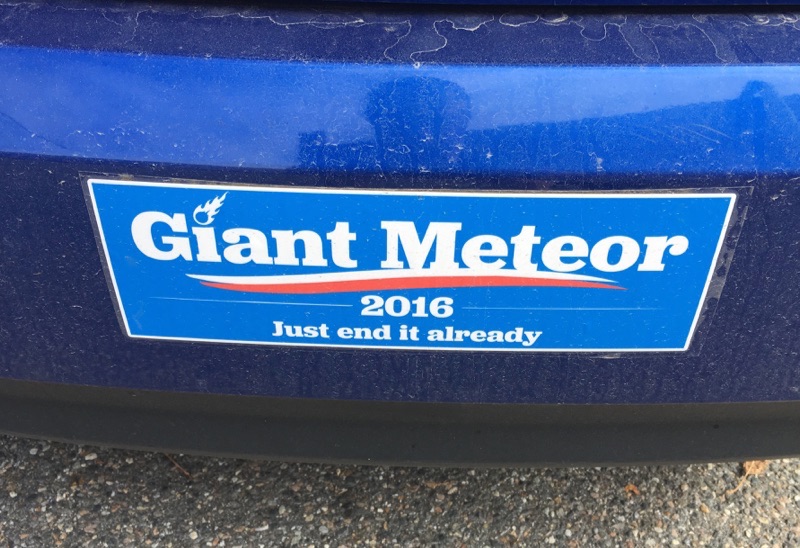
The Best Blue Bumper Sticker
This was the best blue bumper sticker I saw during this election season…
Nov 12
IAB Warns That Internet Standards Will No Longer Be Based on IPv4, only IPv6
 This month the Internet Architecture Board (IAB) provided another reason for organizations to think more about migrating their applications and services to IPv6. In a strong statement, the IAB warned other standards development organizations (SDOs) that future standards from the Internet Engineering Task Force (IETF) may no longer support IPv4:
The IAB expects that the IETF will stop requiring IPv4 compatibility in new or extended protocols. Future IETF protocol work will then optimize for and depend on IPv6.
This will not happen immediately, of course, but the IAB statement notes that levels of IPv6 deployment are increasing and that SDOs need to ensure that current and future standards can work in an IPv6-only environment.
The key point for organizations and companies with applications is that you need to be seriously thinking about ensuring that your apps can work in IPv6-only networks.
To prepare, I would of course welcome you to buy the book, but there are also resources available online that can help you get started. The important thing is to get started NOW!
Nov 12
IAB Warns That Internet Standards Will No Longer Be Based on IPv4, only IPv6
This month the Internet Architecture Board (IAB) provided another reason for organizations to think more about migrating their applications and services to IPv6. In a strong statement, the IAB warned other standards development organizations (SDOs) that future standards from the Internet Engineering Task Force (IETF) may no longer support IPv4:
The IAB expects that the IETF will stop requiring IPv4 compatibility in new or extended protocols. Future IETF protocol work will then optimize for and depend on IPv6.
This will not happen immediately, of course, but the IAB statement notes that levels of IPv6 deployment are increasing and that SDOs need to ensure that current and future standards can work in an IPv6-only environment.
The key point for organizations and companies with applications is that you need to be seriously thinking about ensuring that your apps can work in IPv6-only networks.
To prepare, I would of course welcome you to buy the book, but there are also resources available online that can help you get started. The important thing is to get started NOW!
Nov 11
Rough Guide to IETF 97: DNSSEC, DANE and DNS Privacy and Security
DNS privacy will get a good bit of focus at the IETF 97 meeting in Seoul with a special tutorial as well as a meeting of the DPRIVE working group and activity in the IETF 97 Hackathon. DNS privacy will also come up in the DNSSD group this time, too. The DNS Operations working group will meeting and a new DNS BOF will take place. In contrast to the past few meetings, the Using TLS in Applications (UTA) working group where DANE has been discussed will not meet as their work is moving along on the mailing lists. SImilarly, the DANE working group felt that work was moving along and no physical meeting was needed.
Dan York