
Just a guy in Vermont trying to connect all the dots...

Dan York
Author's posts
Feb 16
3 IETF Mailing Lists To Follow For Monitoring DNSSEC
Would you like to monitor the ongoing evolution of IETF standards related to DNSSEC? If so, here are 3 IETF working group mailing lists you may consider joining. All lists are open to anyone to join. Do note that several of these can have a very large amount of traffic. Each of the mailing list pages also contains a link to the mailing list public archives if you would like to see what is going on in the lists prior to (or instead of) subscribing.
- dnsext mailing list – dnsext charter
The DNS has a large installed base and repertoire of protocol specifications. The DNSEXT working group will actively advance DNS protocol-related RFCs on the standards track while thoroughly reviewing further proposed extensions. The scope of the DNSEXT WG is confined to the DNS protocol, particularly changes that affect DNS protocols “on the wire” or the internal processing of DNS data. DNS operations are out of scope for the WG.
- dnsop mailing list – dnsop charter
The DNS Operations Working Group will develop guidelines for the operation of DNS software servers and the administration of DNS zone files. These guidelines will provide technical information relating to the implementation of the DNS protocol by the operators and administrators of DNS zones
- dane mailing list – DANE charter
The DNS-based Authentication of Named Entities (dane) working group will specify mechanisms and techniques that allow Internet applications to establish cryptographically secured communications by using information distributed through DNSSEC for discovering and authenticating public keys which are associated with a service located at a domain name.
For more information about the DANE working group, see the article in the October 2011 IETF Journal: “DANE: Taking TLS Authentication to the Next Level Using DNSSEC“
Feb 15
Slides: The Case For IPv6-Only Data Centers
Why don’t we just skip dual-stack and other transition technologies and jump straight to IPv6-only data centers that use a gateway/proxy server to service IPv4 requests? That’s the fundamental question Tore Anderson posed in his presentation to the V6 World Congress last week in Paris: “The Case For IPv6-Only Data Centers” (PDF). Here’s what was for me the key slide:
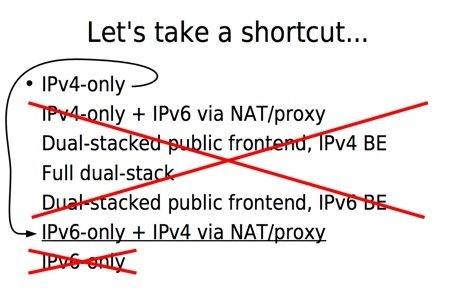
Tore goes on to explain how this can be done using Stateless IP/ICMP Translation (SIIT), also known as “Stateless NAT64″ and “IVI” and defined in RFC 6052 and RFC 6145. Through a series of examples and diagrams he shows how IPv4 traffic would pass through the SIIT gateways into the IPv6 data center and then back out again. He explains the advantages of this setup and concludes with a configuration example and remarks that he’s using this exact setup for his own website and that of his employer.
It’s certainly an intriguing approach and I’m now thinking I may work on setting this up in my IPv6 lab I’m working on.
What do you think? Do you like the idea of just migrating once to an IPv6-only data center?
Feb 15
Google’s Public DNS Works With IPv6 – Can Help In Your Migration
 In a post out yesterday, “Google Public DNS: 70 billion requests a day and counting“, Google reminded us all that their Public DNS service supports IPv6 at these addresses:
2001:4860:4860::8888
2001:4860:4860::8844
From Google’s post:
We’ve also taken steps to help support IPv6. On World IPv6 Day, we announced our IPv6 addresses: 2001:4860:4860::8888 and 2001:4860:4860::8844 to supplement our original addresses, 8.8.8.8 and 8.8.4.4.
If you are working in an IPv6 environment, you can configure your system to point to these addresses for DNS services. (Typically in the settings or control panel for your operating system.) This can greatly help as you migrate your network to IPv6 or establish a trial network.
With World IPv6 Launch coming up on June 6, 2012, it’s great to have resources like these from Google that allow people to work in an IPv6 world!
Feb 15
Valuable Info In EU’s “Good Practices Guide” for DNSSEC Deployment
 Looking for a good concise guide to the security issues and procedures related to deploying DNSSEC? Back in March 2010, the European Network and Information Security Agency (ENISA) issued their “Good Practices Guide For Deploying DNSSEC” with the abstract:
Deploying DNSSEC requires a number of security details and procedures to be defined and followed with specific requirements as to timing. This guide addresses these issues from the point of view of information security managers responsible for defining a policy and procedures to secure the DNS services of a company or an organisation, and from the point of view of competent authorities defining or regulating requirements for deployment.
Coming in at only 29 pages, the document provides a good overview of the issues you need to be thinking about and the steps you need to go through when deploying DNSSEC. While the guide was created prior to the signing of the root zone in July 2010, it still is very accurate in outlining what needs to be done.
Well worth a look if you are looking for whitepapers and similar documents around DNSSEC deployment.
Feb 14
Network Computing: Time To Buckle Down and Start an IPv6 Project
 Over on the Network Computer site, author Robert Mullins recently said it’s time to buckle down and start an IPv6 project. The first of an apparent three-part series, this article primarily provides an overview of the issues around the transition to IPv6, mentions the upcoming World IPv6 Launch, addresses the “chicken and egg” situation around IPv6 deployment and suggests that organizations look at trying some kind of IPv6 project.
According to the article, part two of the series will look at how to deploy an IPv6 network on top of an existing IPv4 network.
The author very nicely mentions Deploy360 (thanks!) and this is what we’re here for! We want to help you get IPv6 deployed in some way within your network and organization. Please do take a look at the many IPv6 resources we have available… and if you can’t find what you are looking for, please let us know so that we can find those resources!
Feb 14
4 IETF Mailing Lists To Follow For Monitoring IPv6
Want to monitor the ongoing evolution of IETF standards related to IPv6? Here are 4 mailing lists and the associated IETF working groups you may consider joining. All lists are open to anyone to join. Note that several of these can have a very large amount of traffic. Each of the mailing list pages also contains a link to the mailing list public archives if you would like to see what is going on in the lists prior to (or instead of) subscribing.
- v6ops mailing list – v6ops charter
The IPv6 Operations Working Group (v6ops) develops guidelines for the operation of a shared IPv4/IPv6 Internet and provides operational guidance on how to deploy IPv6 into existing IPv4-only networks, as well as into new network installations.
- 6man mailing list - 6man charter
The 6man working group is responsible for the maintenance, upkeep, and advancement of the IPv6 protocol specifications and addressing architecture. It is not chartered to develop major changes or additions to the IPv6 specifications. The working group will address protocol limitations/issues discovered during deployment and operation. It will also serve as a venue for discussing the proper location for working on IPv6-related issues within the IETF.
- 6lowpan mailing list - 6lowpan charter
The 6lowpan Working Group has completed two RFCs: “IPv6 over Low-Power Wireless Personal Area Networks (6LoWPANs): Overview, Assumptions, Problem Statement, and Goals” (RFC4919) that documents and discusses the problem space and “Transmission of IPv6 Packets over IEEE 802.15.4 Networks” (RFC4944) which defines the format for the adaptation between IPv6 and 802.15.4.The Working Group will generate the necessary documents to ensure interoperable implementations of 6LoWPAN networks and will define the necessary security and management protocols and constructs for building 6LoWPAN networks, paying particular attention to protocols already available.
6lowpan will work closely with the Routing Over Low power and Lossy networks (roll) working group which is developing IPv6 routing solutions for low power and lossy networks (LLNs).
- 6renum mailing list - 6renum charter
As outlined in RFC 5887, renumbering, especially for medium to large sites and networks, is currently viewed as an expensive, painful, and error-prone process, avoided by network managers as much as possible.
The task of the 6RENUM working group is to document existing renumbering practices for enterprise site networks and to identify specific renumbering problems or ‘gaps’ in the context of partial or site-wide renumbering. Completion of these tasks should provide a basis for future work to identify and develop point solutions or system solutions to address those problems or to stimulate such development in other working groups as appropriate.
6RENUM is chartered to perform an analysis of IPv6 site renumbering. If the analysis leads to conclusions that are also applicable to IPv4 that will be an advantage, but it is not an objective of the WG to make its outputs more widely available than IPv6. Similarly the WG is targeting enterprise networks, but the analysis may also be applicable to SOHO or other (e.g. ad-hoc) scenarios.
There are other IETF Working Groups (see full list) that may handle other IPv6 interactions, for instance the BEHAVE working group handling NAT issues, but these are the primary working groups working on IPv6 issues.
Feb 13
World IPv6 Launch Coming On June 6, 2012 – Will Your Apps Work with IPv6?
 On June 6, 2012, World IPv6 Launch will mark the time when IPv6 is permanently enabled by many operators, website operators, content providers and organizations around the world.
Will your application(s) work on IPv6? What will you need to do to make sure that your apps work as well on IPv6 as on IPv4?
The main point of the book was to help you think through the questions and look at what you need to do.
Will you be ready?
Feb 13
ICANN DNSSEC Workshop March 14 in Costa Rica
 Will you be at the ICANN 43 meeting taking place in San José, Costa Rica, in March 2012? If so, on Wednesday, March 14, 2012, there will be a “DNSSEC Workshop” bringing together people to discuss current and future DNSSEC deployment. Information is not yet available on the ICANN 43 website, but the call for proposals indicated that they were seeking talks on:
1. DNSSEC activities in Latin America
2. The realities of running DNSSEC
3. DNSSEC and the Finance Industry
4. When unexpected DNSSEC events occur
5. DNSSEC in the wild
6. DANE and other DNSSEC applications
I (Dan York) will be there in Costa Rica at the session and am definitely looking forward to joining in the conversation and listening and learning. If you will be there at the session, please do say hello (or drop me a note in advance). You can also expect to see information posted here to our blog coming out of that session.
P.S. If you want to attend, there is still time to register for the ICANN 43 meeting. I’m told the DNSSEC Workshop will also be streamed live. As soon as we have the live-streaming information we’ll post that here.
Feb 13
NLnet Labs Makes Their DNSSEC Training Materials Freely Available For All To Use
Want to offer your own DNSSEC training courses? Or want to run an internal DNSSEC training class? Or want to give a DNSSEC presentation to a local user group? Or are you simply looking for material to help you learn more about DNSSEC?
If you answered yes to any of those questions, Olaf Kolkman and the team at NLnet Labs have given the Internet community a wonderful gift in the form of DNSSEC course materials that are freely available for usage and modification (subject to attribution). The slides are all part of a DNSSEC “Train the Trainer” course that Olaf recently gave and are available in PowerPoint, Keynote and PDF form from:
The materials are licensed under a permissive Creative Commons license that basically lets you do whatever you want to the materials, including modify them and use them for commercial training, provided you include the appropriate attribution link.
It’s great that the NLnet Labs team has made this material available and we hope that people across the Internet find it a useful way to teach about DNSSEC and get more people using DNSSEC!
Thanks, Olaf and NLnet Labs!