Just a guy in Vermont trying to connect all the dots...

Dan York
Author's posts
Jun 06
On the 7th World IPv6 Launchiversary, How About Listening to a Podcast About IPv6?

On this 7th “launchiversary” of World IPv6 Launch, I thought I’d share a way I’ve enjoyed learning more about IPv6 over the past year. I like listening to podcasts while I’m running or driving, and a show that’s in my playlist is “IPv6 Buzz” where IPv6 veterans Ed Horley, Scott Hogg, and Tom Coffeen “dive into the 128-bit address space wormhole.“
Anyone working with IPv6 for any amount of time, and particularly IPv6 advocacy, has probably read or heard something from Ed, Scott, or Tom. They’ve been explaining and promoting IPv6 for a long time in their own individual endeavors.
This podcast, which launched one year ago today, brings the three of them together with a wide range of guests from across the industry. Even with all my own years of IPv6 activity, I’ve learned a great amount about IPv6 security, recent drivers of deployment (including state task forces), tools and suggestions for promoting IPv6 growth. They dove deeply into IPv6 inside the IETF with Fred Baker, talked about going IPv6-only with Veronika McKillop of Microsoft, got into Happy Eyeballs with Dan Wing, and most recently explored enterprise IPv6 issues with Enno Rey.
Part of the excellent “Packet Pushers” network of podcasts, I’ve found it a great way to stay up on what is happening in the world of IPv6. If you listen to podcasts and are interested in IPv6, do check it out!
P.S. And if you have not yet started deploying IPv6, you can begin by exploring some of our Deploy360 resources.
Image Credit: Boris Smokrovic on Unsplash
The post On the 7th World IPv6 Launchiversary, How About Listening to a Podcast About IPv6? appeared first on Internet Society.
May 13
Know Someone Who Has Made the Internet Better? Postel Service Award Nominations Deadline May 15 (Featured Blog)
Do you know of someone who has made the Internet better in some way who deserves more recognition? Maybe someone who has helped extend Internet access to a large region? Or wrote widely-used programs that make the Internet more secure? Or maybe someone who has been actively working for open standards and open processes for the Internet? More...
May 13
Know Someone Who Has Made the Internet Better? Postel Service Award Nominations Deadline May 15 (Featured Blog)
Do you know of someone who has made the Internet better in some way who deserves more recognition? Maybe someone who has helped extend Internet access to a large region? Or wrote widely-used programs that make the Internet more secure? Or maybe someone who has been actively working for open standards and open processes for the Internet? More...
Apr 07
Celebrating 50 Years of the RFCs That Define How the Internet Works
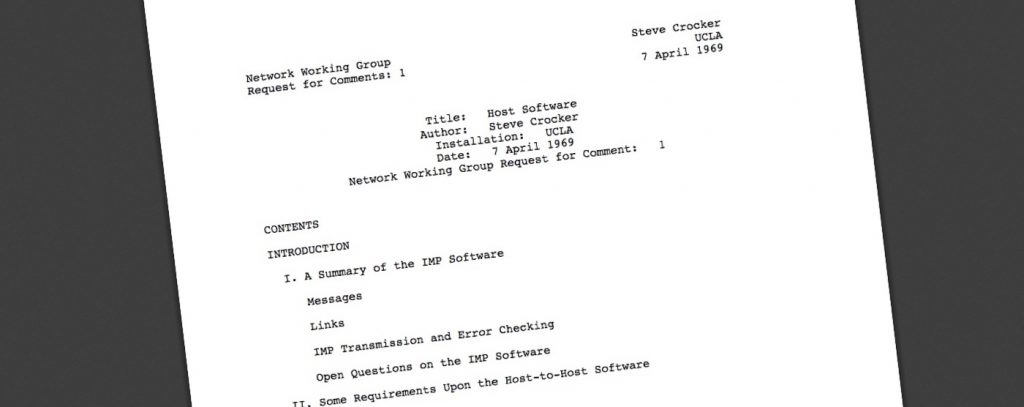
50 years ago today, on 7 April 1969, the very first “Request for Comments” (RFC) document was published. Titled simply “Host Software”, RFC 1 was written by Steve Crocker to document how packets would be sent from computer to computer in what was then the very early ARPANET. [1]
Steve and the other early authors were just circulating ideas and trying to figure out how to connect the different devices and systems of the early networks that would evolve into the massive network of networks we now call the Internet. They were not trying to create formal standards – they were just writing specifications that would help them be able to connect their computers. Little did they know then that the system they developed would come to later define the standards used to build the Internet.
Today there are over 8,500 RFCs whose publication is managed through a formal process by the RFC Editor team. The Internet Engineering Task Force (IETF) is responsible for the vast majority (but not all) of the RFCs – and there is strong process through which documents move within the IETF from ideas (“Internet-Drafts” or “I-Ds”) into published standards or informational documents[2].
50 years ago, one of the fundamental differences of the RFC series from other standards at the time was that:
- anyone could write an RFC for free.
- anyone could read the RFCs for free. They were open to all to read, without any fee or membership
As Steve Crocker notes in his recollections, this enabled the RFC documents to be widely distributed around the world, and studied by students, developers, vendors and other professionals. This allowed people to learn how the ARPANET, and later the Internet, worked – and to build on that to create new and amazing services, systems and software
This openness remains true today. While the process of publishing a RFC is more rigorous, anyone can start the process. You are not required to be a member (or pay for a membership) to contribute to or approve standards. And anyone, anywhere, can read all of the RFCs for free. You do not have to pay to download the RFCs, nor do you have to be a member of any organization.
More than anything, this open model of how to work together to create voluntary open standards is perhaps the greatest accomplishment of the RFC process. The Internet model of networking has thrived because it is built upon these open standards.
Standards may come and go over time, but the open way of working persists.
While we may no longer use NCP or some of the other protocols defined in the early RFCs, we are defining new protocols in new RFCs. The next 1,000s RFCs will define many aspects of the Internet of tomorrow.[3]
We may not know exactly how that future Internet will work, but it’s a pretty good guess that it will be defined in part through RFCs.
- See also: Fifty Years of RFCs – reflections from current RFC Editor Heather Flanagan.
[1] See our History of the Internet page for more background.
[2] For more explanation of the different types of RFCs, see “How to Read a RFC“.
[3] As noted in our 2019 Global Internet Report section on “Takeaways and Observations”, we are concerned that an increasing number of new services and applications on the Internet are relying on application programming interfaces (APIs) controlled by the application or platform owner rather than on open standards defined by the larger Internet community.
The post Celebrating 50 Years of the RFCs That Define How the Internet Works appeared first on Internet Society.
Mar 30
TDYR 361 – Reflections on IETF 104 in Prague
I was in Prague for the 104th meeting of the Internet Engineering Task Force (IETF) and in this episode I talk about some of what went on there...
Mar 18
TDYR 360 – What was the Internet like before the Web? Celebrating 30 years of the Web – #Web30
What was the Internet like before the Web? How did the Web change our online communication so dramatically? Last week (March 12) was the 30th anniversary of Tim Berners-Lee starting the World Wide Web, and in this episode I reflect on what the Internet was like before. Read more: https://www.internetsociety.org/blog/2019/03/celebrating-the-30th-anniversary-of-the-world-wide-web/
Mar 12
Celebrating the 30th Anniversary of the World Wide Web
Back around 1991, I was traveling throughout the eastern USA teaching an “Introduction to the Internet” course I had written. The students were mainly from telecom, financial, and software companies wanting to know what this Internet thing was all about. I taught about IP addresses and DNS, using email, sending files with FTP, using archie and veronica to find info, engaging in USENET discussions, and using Gopher to explore “gopherspace”.
At the end of the course, one of the final sections was on “emerging technologies”. And there, nestled in with HyTelnet and WAIS, was one single page about this new service called the “World-Wide Web”.
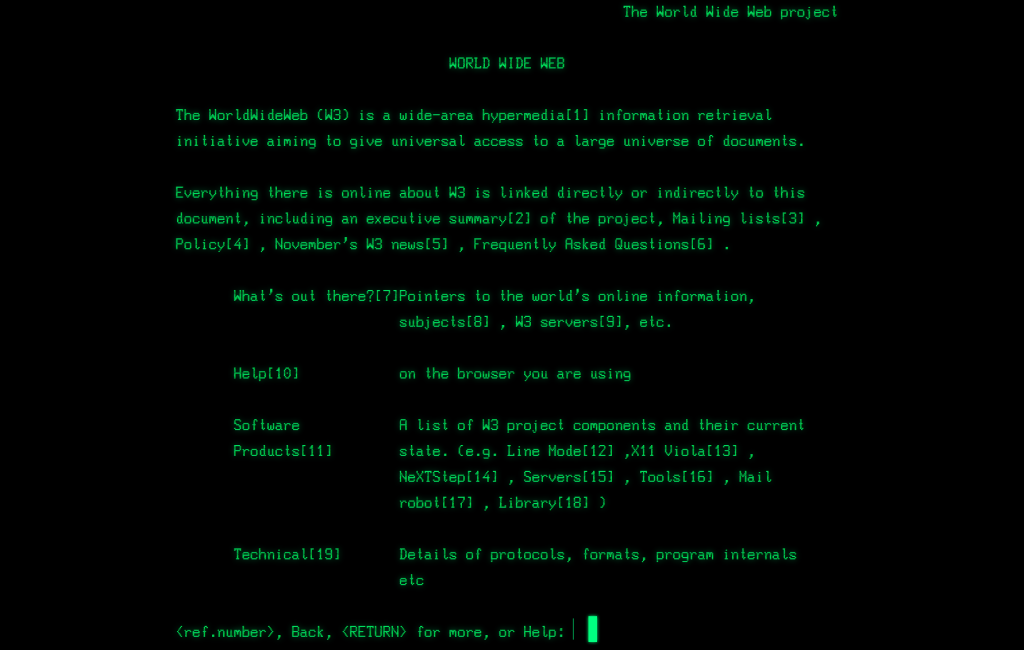
And all the page really said was: telnet to info.cern.ch, login as “www”, and start pressing numbers to follow links on the screen.
That was it! (and you can still experience that site today)
We had no idea in those very early days that what we were witnessing was the birth of a service that would come to create so much of the communication across the Internet.
In only a few short years, of course, I was teaching new courses on “Weaving the Web: Creating HTML Documents” and “Navigating the World-Wide Web using Netscape Navigator“. And all around us there was an explosion of content on the Internet as “everyone” wanted to create their own websites.
The Web enabled anyone to publish and to consume content (assuming they could get access to the Internet). Content finally broke free from the “walled gardens” of the proprietary commercial online services such as CompuServe, AOL, Prodigy, and others. The Web brought an open layer of publishing, communication, and commerce to the gigantic open network of networks that is the Internet. It was a perfect example of the “permissionless innovation” allowed by an open, globally-connected Internet, where no one has to ask permission before creating new services.
Whole new industries were born, while others faded away. New words entered our vocabulary. (ex. before the Web, who used the word “browser”?) New opportunities emerged for so many people around the world. Lives were changed. Education changed. Economies changed. The very fabric of our society changed.
While it is true that the Web could not exist without the Internet, the Internet would not be as amazing as it is without the Web.
And so on this momentous day, we join with the people at CERN, the World Wide Web Consortium (W3C), the World Wide Web Foundation, Tim Berners-Lee, and so many others in celebrating the 30th anniversary of the Web.
The path forward for the next 30 years of the Web, which relies on the Internet to flourish, is not so clear. It is a challenging time for the Internet. And the intensity of the consolidation and centralization within the Internet economy has caused Tim Berners-Lee himself to issue a call to re-decentralize the Web.
But for today, let us focus on all the good the Web has brought to the Internet, all the people it has helped, all the lives it has transformed.
Happy 30th birthday to the Web!
Image credit: CERN’s re-created info.cern.ch.
The post Celebrating the 30th Anniversary of the World Wide Web appeared first on Internet Society.
Jan 30
Call for Proposals: ICANN 64 DNSSEC Workshop in Kobe, Japan (March 2019) (Featured Blog)
Will you be at the ICANN 64 meeting in March 2019 in Kobe, Japan? If so (or if you can get to Kobe), would you be interested in speaking about any work you have done (or are doing) with DNSSEC, DANE or other DNS security and privacy technologies? If you are interested, please send a brief (1-2 sentence) description of your proposed presentation before 07 February 2019. More...
Jan 30
Call for Proposals: ICANN 64 DNSSEC Workshop in Kobe, Japan (March 2019) (Featured Blog)
Will you be at the ICANN 64 meeting in March 2019 in Kobe, Japan? If so (or if you can get to Kobe), would you be interested in speaking about any work you have done (or are doing) with DNSSEC, DANE or other DNS security and privacy technologies? If you are interested, please send a brief (1-2 sentence) description of your proposed presentation before 07 February 2019. More...