
Just a guy in Vermont trying to connect all the dots...

Dan York
Author's posts
Dec 27
Youth Curling Open House – Fri, Dec 28, 1-3pm – Petersham, MA
Youth Curling Open HouseCurling is a fun team sport that is open to pretty much anyone to be able to play. I play in an adult league on Tuesday nights and my 10-year-old daughter (pictured) plays in the youth curling on Saturday mornings. It's about a 45-minute drive for us from Keene, NH, but it's worth it to play on good ice and learn the sport.
Friday, December 28, 2012 from 1-3pm
Petersham Curling Club, Petersham, MA
You are welcome to come by tomorrow and try it out. The open house is free and directions are available on the Petersham Curling Club website.
If you can't make it tomorrow but are interested in staying up on future events like this, we also have a Facebook page for the Petersham Youth Curling that you can "Like" and stay connected.
We'd welcome any youth who would like to join us on the regular Saturday mornings... it's a great amount of fun!
Dec 27
Sledding at Robin Hood Park
 |
via YouTube Capture. |
From:
Dan York
Views:
27
 0
ratings |
| Time: 00:23 | More in People & Blogs |
Dec 26
IPv6 Kongress 2013 Call For Papers Deadline of January 20
 The IPv6 Kongress 2013 is scheduled for June 6 and 7 in Frankfurt, Germany, and the program committee there has issued a call for papers seeking presenters on IPv6 topics. Some of the session topics they are seeking include:
- IPv6 und Smartphones respektive Tablets
- IPv6-spezifische Sicherheitsprobleme
- Einführungsverfahren in Firmennetzen
- Privacy und Datenschutz
- Praxisrelevante Unterschiede zwischen altem und neuem Protokoll
- IPv6 in Embedded Systems
- IPv6-Goodies – was uns ohne IPv6 bislang alles entgangen ist …
Obviously, the conference is in German… although “IPv6-Goodies” is probably understandable in any language! 
The deadline to submit a proposal is January 20, 2013. More info on the call for papers page.
Dec 24
Google+ Available Over IPv6
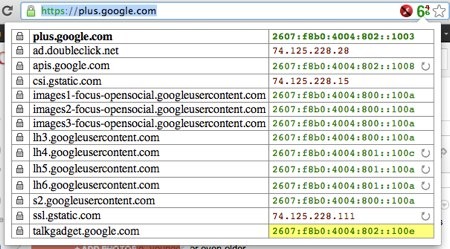 For those of us who are fans of Google+ and also IPv6, we were pleased to note that Google+ is accessible over IPv6.
Now, it may have honestly been this way for a while, but a Google+ update from Wes Hardaker made me pay attention to this fact. Using the outstanding IPvFoo extension for Google Chrome (similar to the IPvFox add-on for Firefox), I could easily see that yes, indeed, my connection to Google+ was over IPv6.
It’s always interesting to click on the IPvFoo icon in my browser address bar and see what is not coming to me over IPv6, and in this case it seems to be ads being served by DoubleClick and whatever content is coming from gstatic.com:
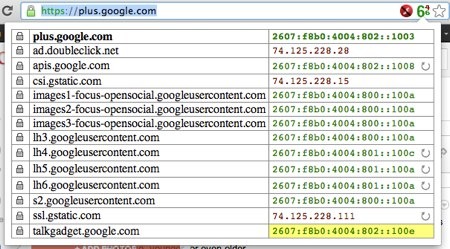
However, everything else is coming in over IPv6!
Now, sometimes that does change, I’ve noticed, but I expect that is simply a result of Chrome’s “Happy Eyeballs” implementation where it may sometimes find IPv4 to be faster than IPv6.
All in all it’s good to see… now we have both Google+ and Facebook accessible over IPv6. Now we just need to get Twitter over IPv6!
P.S. While you’re over on Google+ checking this out, how about adding our Deploy360 page to a circle and giving us a +1? We’d love to interact with you over there.
Dec 24
FIR #683 – 12/24/12 – For Immediate Release
Cy Jervis interview is up, Ekaterina Walter interview is coming; FIR Android app is in Amazon app store; Quick News: Kudos to New York Times for integrating multimedia into an article, 18 UK government departments publish digital strategies, study shows quality content earns word of mouth, anonymous social network Social Number launches; Ragan promo; News That Fits: social media press release template 2.0, Michael Netzley's Asia report, Media Monitoring Minute from CustomScoop, update on IABC kerfuffle, listener comments, TemboSocial promo, Dan York's report; how to comment; music from The Mighty Whispers; and more.
Dec 21
Whoops! No Mayan Apocalypse… you DO have to deploy IPv6!
 What? You thought the Mayan apocalypse would save you from deploying IPv6?
Sorry… but no, if you are reading this, the end of the world did not happen and you still do need to get on about the business of deploying IPv6!
Why not check out these IPv6 tutorials and get started? Or check out all of our IPv6 resources?
The world isn’t ending… but the supply of IPv4 addresses IS… so why not end out 2012 by looking at what you have to do to get started with IPv6?
Dec 21
Introducing a New Deploy360 Topic: Routing Resiliency / Routing Security

© istock photo / Andrey Prokhorov
How reliable and secure is the Internet’s underlying routing infrastructure? How well does it hold up in the face of a major event such as the recent Hurricane Sandy that hit the US? How well can it withstand attacks and misconfiguration errors? As we continue to move more and more of our communication into the “cloud” of the Internet, how secure and reliable is the underlying routing fabric that holds it all together?
Over the past year here at Deploy360, we have been talking a great deal about how we need to get IPv6 deployed to enable more connections to the Internet… more networks, more devices, more “Internet of Things” and more people as there are still 5 billion people yet to get online. We’ve also been talking about how we need to get DNSSEC more widely deployed to create a more secure Internet and to enable a whole new realm of innovations such as the DANE protocol that can create a stronger security layer.
But it’s become increasingly clear to us that as we get more people connected to the Internet and even as we add security layers like DNSSEC, there is another area where we need to greatly increase the conversation.
The truth is… the Internet today IS highly reliable, even in the cases of events like Hurricane Sandy. The Internet, as we like to say, “routes around damage.” Even in the face of malicious attacks to sections of the Internet, the overall network has continued to function.
But…
… as the Internet continues to evolve and the number of network operators expands… as we bring the next billion people online… as we interconnect even more devices and things… we need to ensure that the Internet’s underlying routing infrastructure is both reliable and secure. There is room today for improvement.
A New Topic: Routing
And so we are launching a new area on our site that we are calling simply “Routing“, where we will focus on providing real-world deployment information to the global operator community related to “routing security” and “routing resiliency.”
The term “resiliency” is an important one, and a common definition for a network is:
the ability of the network to provide and maintain an acceptable level of service in the face of various faults and challenges to normal operation.
Ultimately that is our goal – doing what we can to work with the operator community to ensure the resilience of the Internet’s routing infrastructure. A part of that is “routing security,” but the topic is really much larger and dives into operational practices, policies and other areas.
As we have with IPv6 and DNSSEC (and will be continuing to do as we build out our roadmaps for those topics), we’ll start with a foundation of information including:
- Reports and studies on best current operational practices (BCOPs) for routing resiliency and security
- Case studies of how BCOPs are deployed and effectively used – as well as case studies of recent routing incidents
- Tools that can be used to help better understand how resilient and secure your routing infrastructure is
- Sites with statistics and data to help you understand the overall situation
We’ll focus on finding or creating the best tutorials, whitepapers, reports, videos, statistics, sites and tools, just as we’ve done with IPv6 and DNSSEC. As in the other topics, we’ll be looking to promote resources created by many of you who are reading this message. And where we can’t find resources others have created, we’ll go ahead and create them either ourselves or through partners. We’ll also naturally be adding in routing-related posts to our constant stream of more news-related blog posts.
Note that this “routing resiliency/security” topic will be a bit different than our other areas in that we are not focusing on a specific protocol but rather on a broader topic.
Certainly over the next few months after we’ve built the foundation we will explore some of the protocols that are being discussed now within the IETF such as Secure BGP (BGPSEC) and the Resource Public Key Infrastructure (RPKI) – but they will again be discussed within this broader context of how they are part of the puzzle – “building blocks,” really – of making the Internet more resilient and secure. We’ll also be integrating and promoting some of the routing security work we’ve been doing for some time now, such as the routing security “operator roundtables” we’ve held.
It’s an ambitious topic … and more than one person has said to us something like “Wow! Making DNSSEC and IPv6 interesting was hard enough… now you are going to dive down into BGP and the guts of routing? Are you crazy?” And yes, we’re aware that the community of people who even know about all this stuff is tiny, let alone those who reallyunderstand it.
But that’s what we want to change! We want more people to understand how the Internet really works down underneath, so that they, too, can understand what we need to do to ensure it continues to be the vibrant Internet we’ve come to expect.
It’s important, too, for the future of the open Internet… and for the billions of people and devices yet to connect. As a report from ENISA so nicely puts it:
There may well not be an immediate cause for concern about the resilience of the Internet interconnection ecosystem, but there is cause for concern about the lack of good information about how it works and how well it might work if something went very badly wrong.
We aim to help change that!
How You Can Help
Want to join us in this quest to improve routing resiliency and security? While we’re starting to add resources and pages to the site, there are a couple of ways you can help us out:
1. Read the reports we’ve listed. You may want to start with the excellent report, “Inter-X: Resilience of the Internet Interconnection Ecosystem,” that summarizes the situation and offers suggestions for how to move forward. The 31-page summary document is enough to get started … although the truly hard-core may enjoy the 239-page “full” report. From there you can move on to the other documents for a deeper understanding.
2. Send us suggestions – if you know of a report, whitepaper, tutorial, video, case study, site or other resource we should consider adding to the site, please let us know. We have a list of many resources that we are considering, but we are always looking for more.
3. Volunteer – if you are very interested in this topic and would like to actively help us on an ongoing basis, please fill out our volunteer form and we’ll get you plugged in when we get the volunteer effort going in the next few months.
4. Help us spread the word – As we publish resources and blog posts relating to routing resiliency / security, please help us spread those links through social networks so that more people can learn about the topic.
With your help, we can build out this Routing area of Deploy360 to be an outstanding resource for the Internet community and to help make the Internet more resilient and secure!
Dec 20
ENISA Report: Resilience of the Internet Interconnection Ecosystem
 Seeking to understand routing resiliency and routing security? In this April 2011 report, “Inter-X: Resilience of the Internet Interconnection Ecosystem
“, the European Network and Information Security Agency (ENISA) provides an extremely thorough understanding of the complex ecosystem of connections between networks.
This document is highly recommended to anyone looking to understand how the Internet operates – and where there are opportunities for improvement.
As noted on the introductory web page, the study:
…looks at the resilience of the Internet interconnection ecosystem. The Internet is a network of networks, and the interconnection ecosystem is the collection of layered systems that holds it together. The interconnection ecosystem is the core of the Internet, providing the basic function of reaching anywhere from everywhere.
where “resilience” is defined as:
the ability to provide and maintain an acceptable level of service in the face of various faults and challenges to normal operation.
The comprehensive study outlines the challenges to both measuring the infrastructure of the Internet and to understanding the resilience of the network. A key point is:
There may well not be an immediate cause for concern about the resilience of the Internet interconnection ecosystem, but there is cause for concern about the lack of good information about how it works and how well it might work if something went very badly wrong.
The report sets out to capture a good bit of that information and to lay out recommendations about how further work may be undertaken. The document is available in two versions:
- a 31-page “Executive Summary” report (PDF) that presents the major findings and recommendations and provides a decent tutorial into the issues and challenges.
- a 239-page “Full” report (PDF) that goes into great detail about the “state of the art” with regard to routing and Internet interconnections, includes a section about how the report was developed and then includes a lengthy bibliography that is very useful in and of itself.
While originating in Europe, the document and its recommendations are globally applicable.
For a taste of the document, here is the table of contents of the Executive Summary report:
1 Summary
- 1.1 Scale and Complexity
- 1.2 The Nature of Resilience
- 1.3 The Lack of Information
- 1.4 Resilience and Efficiency
- 1.5 Resilience and Equipment
- 1.6 Service Level Agreements (SLAs) and ‘Best Efforts’
- 1.7 Reachability, Traffic and Performance
- 1.8 Is Transit a Viable Business?
- 1.9 The Rise of the Content Delivery Networks
- 1.10 The “Insecurity” of BGP
- 1.11 Cyber Exercises on Interconnection Resilience
- 1.12 The “Tragedy of the Commons”
- 1.13 Regulation
2 Recommendations
- Incident Investigation
- Data Collection of Network Performance Measurements
- Research into Resilience Metrics and Measurement Frameworks
- Development and Deployment of Secure Inter‐domain Routing
- Research into AS Incentives that Improve Resilience
- Promotion and Sharing of Good Practice on Internet Interconnections
- Independent Testing of Equipment and Protocols
- Conduct Regular Cyber Exercises on the Interconnection
- Infrastructure
- Transit Market Failure
- Traffic Prioritisation
- Greater Transparency – Towards a Resilience Certification Scheme
More information about the report can be found on the ENISA web site.