Just a guy in Vermont trying to connect all the dots...

Dan York
Author's posts
Dec 14
TDYR 196 – “Surprise Me, Santa”, A Fascinating Side Effect Of Raising A Child Without Commercial TV
At a "Breakfast with Santa" yesterday, Santa asked our 5-year-old daughter about what she wanted for Christmas...
Dec 14
Video: The Keene Interfaith Community Breakfasts
One of the great changes in my life over the past year has been helping out at the community breakfasts for the homeless that happen now each winter weekday morning at our church in Keene, NH. While they are held in our church building, the teams of volunteers who staff the breakfasts also come from several other churches in our community. (In fact, we're looking for one more church or other community group to step forward and help on the one remaining day that needs coverage.)
What are the "community" breakfasts that take place at the Keene UU Church (KUUC) during the winter months? How did they get started? How are they an example of interfaith service programs? And how can people get more involved? In this episode 501 of her show "My Karma Ran Over My Dogma", Rev. Sandra Whippie explores these topics and much more with a panel including:
It's been quite an eye-opening experience for my wife and I, both in terms of learning about the quantity of people in our region who are homeless... but also in hearing some of the stories and knowing that while often it is very definitely choices that get people into these situations, sometimes it is instead circumstances - job losses, medical expenses, family issues - and that the line between those who have and those who have not can be very thin and fragile.
Recently a local community TV show recorded an episode with several of us who have been involved with the community breakfasts. I represented our church and spoke about some of the changes that being involved has brought about with me and our family.
Give it a listen... and if you are in the Keene, NH, area and interested in helping, we're always looking for people to help during these cold winter months!
What are the "community" breakfasts that take place at the Keene UU Church (KUUC) during the winter months? How did they get started? How are they an example of interfaith service programs? And how can people get more involved? In this episode 501 of her show "My Karma Ran Over My Dogma", Rev. Sandra Whippie explores these topics and much more with a panel including:
- Rev. Michael Hall, KUUC minister and member of the Interfaith Clergy Association
- Charlie Gibson, member of the Catholic churches in the Keene area
- Dan York, member of the Keene Unitarian Universalist Church (KUUC)
- Marcia Winters, member of the Keene United Church of Christ (UCC)
P.S. For the purpose of including an image for this post in the "carousel" at the top of the site, I'm including this screenshot of me talking:
Dec 13
Verizon Launches Voice Cypher Secure VoIP Mobile App… With A Government Backdoor
Verizon Wireless this week did something that initially seemed quite impressive – they launched “Voice Cypher”, an app available for iOS, Android and Blackberry that promises secure end-to-end encryption. It uses VoIP and is an “over-the-top” (OTT) app that works on any carrier. If you read the marketing material on their web site, it all sounds great! Indeed their “Learn More” page has all the right buzzwords and security lingo – and says quite clearly: Voice Cypher provides end-to-end encryption between callers, even if the call crosses over multiple networks.” They include the requisite network diagram that shows how it protects against all threats:
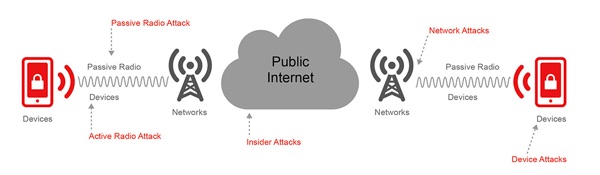
It turns out there’s just one small little detail … as reported by BloombergBusinessweek, the app comes complete with a backdoor so that Verizon could decrypt the phone calls if requested to do so by law enforcement!
As the Businessweek article states:
Cellcrypt and Verizon both say that law enforcement agencies will be able to access communications that take place over Voice Cypher, so long as they’re able to prove that there’s a legitimate law enforcement reason for doing so.
Unfortunately, in this post-Snowden era I don’t know that many of us put a great amount of trust in our governments to only access communications with a “legitimate law enforcement reason”. Or perhaps the concern is that what gets classified as “legitimate” can be widely construed to mean almost anything.
The article does point out that Verizon is bound by CALEA to provide lawful intercept to the phone networks, but points out an interesting caveat that Verizon could have used:
Phone carriers like Verizon are required by U.S. law to build networks that can be wiretapped. But the legislation known as the Communications Assistance for Law Enforcement Act requires phone carriers to decrypt communications for the government only if they have designed their technology to make it possible to do so. If Verizon and Cellcrypt had structured their encryption so that neither company had the information necessary to decrypt the calls, they would not have been breaking the law.
A Verizon Wireless representative indicated that they believe government agencies looking for ways to protect sensitive information may be customers of this service, as may be corporate customers concerned about leaking private information.
But… as we continue to hear more and more information about the massive amount of pervasive monitoring and surveillance by government agencies from many different governments around the world, you do have to wonder how safe those agencies and companies will feel with a “secure” solution that already comes with a backdoor. The problem with a known backdoor is that even if you may trust Verizon Wireless to only allow legitimate law enforcement access… how do you know that some attacker may not be able to penetrate that backdoor? The “secure end-to-end encryption” isn’t entirely secure.
Given that the service has a higher price tag of $45 per month per device, I do wonder how many businesses or agencies will actually embrace the service.
On reading about this Voice Cypher service, it certainly sounds quite interesting. We need more secure voice solutions out there – and it’s very cool that Verizon Wireless is delivering this as an OTT mobile app that will work across different carriers.
It’s just too bad that it’s not truly “secure end-to-end”. 
P.S. I also recorded an audio commentary on this same topic.
Dec 13
TDYR 195 – Verizon’s ‘Secure’ Voice Cypher App… With A Government Backdoor
Verizon came out with a new "Voice Cypher" OTT app for iOS, Android and Blackberry which sounds like a very cool way to have secure voice communication across mobile networks... until you realize that it has a government backdoor already built in. :-(
http://www.businessweek.com/articles/2014-12-11/verizons-new-encrypted-calling-app-comes-prehacked-for-the-nsa
https://www.verizonwireless.com/wcms/business/apps/voice-cypher.html
http://business.verizonwireless.com/content/b2b/en/solutions/technology/mobile-security/voice-cypher.html
Dec 12
Emily Taylor’s Must-Read Post: Ofcom in denial over UK IPv6 failure
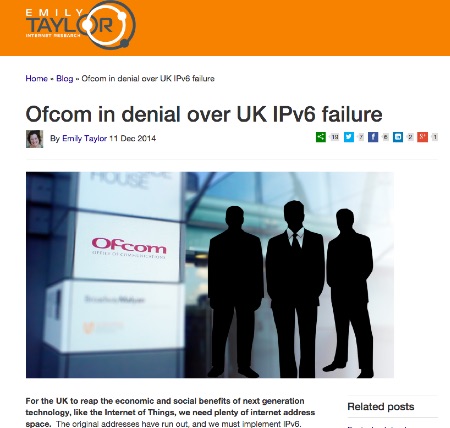
On her blog yesterday, Emily Taylor wrote an outstanding post “Ofcom in denial over UK IPv6 failure” that begins:
For the UK to reap the economic and social benefits of next generation technology, like the Internet of Things, we need plenty of internet address space. The original addresses have run out, and we must implement IPv6. Experts say the UK has been more negative about the adoption of IPv6 than almost any other nation. Various initiatives aimed at stimulating adoption have fizzled out. The big ISPs convey a lack of urgency and Ofcom, rather than pushing industry to adopt, seems more focused on thinking of work-arounds. Why is our regulator failing to show leadership?
I was going to try to summarize her post… but the more I read it, the more I just realized it is brilliantly done as it is. She weaves together many threads such as the Internet of Things, the problems with Carrier-Grade NAT, the issues with the potential selling of IPv4 addresses… any summary won’t do it justice.
And then once you’ve read that, why don’t you please visit our Start Here page to find resources related to IPv6 to help you get started!
We definitely agree with her final quote from Vint Cerf:
“The Internet needs to keep evolving and there are things that should happen beyond IPv6 but to overcome the present address space exhaustion, we need to implement IPv6 essentially everywhere”.
Let’s make it happen!
Dec 12
Congrats To Norway’s .NO On Over 5,000 DNSSEC-Signed Domains!
 Congratulations to the Norid team on going live with DNSSEC for the .NO country-code top-level domain (ccTLD) this week! You may recall we wrote about .NO being signed in the root zone of DNS back on November 18 (and the cake they baked to celebrate!), but this news this week now moves them to the fully “Operational” status in our DNSSEC deployment maps.
As they note on their page about the news, the .NO registry started accepting DNSSEC records from .NO domain registrants on Tuesday, December 9th. They also indicated that they had 16 registrars (and now today I count 17).
Even better… after the first day, Norid’s Unni Solås reported on Twitter that they had passed 3,000 signed .NO domains:
It's 5 PM on .no's #DNSSEC D-day, and we're passing 3K signed domains while I type this. Steady going!
— Unni Solås (@unniquity) December 9, 2014
and on the second day they were over 5,300:
#DNSSEC deployment, day 2: .no passed 5300 signed domains this afternoon.
— Unni Solås (@unniquity) December 10, 2014
Presumably two days later they will have even more DNSSEC-signed domains!
By the way, the Norid folks have a great DNSSEC project description (in English) that walks through the different stages of their deployment. This could be very useful for any other ccTLDs looking to deploy DNSSEC.
Anyway… great work by the Norid team and others there in Norway – and we’re looking forward to hearing more about DNSSEC in Norway.
P.S. If you want to sign your domain with DNSSEC or enable DNSSEC validation on your network, please visit our Start Here page to find resources aimed at your type of organization or role.
Dec 12
Great Story About New Curling Club In Brooklyn, NY

Great post this week in the New York Times about a new curling club starting up in Brooklyn: “In the Borough of Beards, Lay Down Some Ice, and Out Come the Brooms“.
It reports that they had over 100 people turn out for their November Open House and now are setting up more leagues. Two sites to learn more:
Congratulations to the folks there on the launch of their new club!
If you’d like to help us bring curling to the Monadnock region of New Hampshire, please fill out our form and let us know! Thanks!
Dec 12
Great Story About New Curling Club In Brooklyn, NY
Great post this week in the New York Times about a new curling club starting up in Brooklyn: “In the Borough of Beards, Lay Down Some Ice, and Out Come the Brooms“.
It reports that they had over 100 people turn out for their November Open House and now are setting up more leagues. Two sites to learn more:
Congratulations to the folks there on the launch of their new club!
If you’d like to help us bring curling to the Monadnock region of New Hampshire, please fill out our form and let us know! Thanks!
Dec 11
Opinion – A New iPhone App Aiming To Make Podcasting Easy For Everyone
How can podcast creation be made even easier on the iPhone? I recently stumbled upon a new iPhone app called simply "Opinion" that is aimed at making podcasting no longer just "a medium reserved for tech geeks and media corporations" but rather a medium available to everyone.
Given that it's audio, it may be best to listen... so I recorded a "The Dan York Report" podcast today using the app and you can hear my thoughts in the recording:
UPDATE: One quick production note - I recorded this podcast on my iPhone 5s just using the internal microphone of the 5s. I did not attach a headset or any other kind of external mic. (People have asked about this.) I was sitting in a quiet room, but it was just with the raw iPhone 5s microphone. Nothing else.
If you are interested in trying it out yourself, you can download Opinion in the AppStore for the iPhone. As I note in the recording, it will install onto the iPad, but in doing so it just behaves as an iPhone app (i.e. it doesn't make use of the iPhone's screen and just looks like a huge iPhone app).
You can find more info, too, at www.opinionpodcasting.com.
A quick summary of some of my thoughts:
- The app was extremely easy to use.
- I liked how you could stop and start the recording, generating new tracks within the same session. You can then easily move tracks around if you wanted to. For instance, I realized that I had left something out that I wanted to include earlier, so I recorded another track and then moved that back into the earlier flow.
- The editing tool nicely lets you split tracks so, for instance, I could split an existing track to insert a new track.
- I also used the editing tool to remove / trim the ends of tracks. I would cut the track which would create a new track with the audio I wanted to delete - and then I would just delete the track.
- The workflow right now involves having a single "session" inside of the app. When you are done with the recording you upload it to some site or service. When you want to record again you are doing so in the same session, i.e. you need to delete some or all tracks in order to record again. This is in contrast to another app I use, Hindenburg Field Recorder, that lets you save your recording sessions inside the app. I don't think this is necessarily a bad thing, as most of the time I wind up simply deleting the older recording sessions in Hindenburg Field Recorder because they take up space. This "one session" approach has its merits.
- One thing I like about it is that I could use this workflow to make a simple "intro" and "outro" for my TDYR podcasts. It could go like this:
- Record an intro track.
- Record an outro track.
- Record a main episode track and then move it between the intro and outro.
- Upload the finished episode to SoundCloud.
- The next time... delete the main episode track.
- Record a new main episode track.
- Move it between the intro / outro tracks.
- Upload the new finished episode to SoundCloud.
- Repeat....
This could be quite cool!
- I haven't tried it yet, but the app has the ability to import music from your iPhone's Music library. You could then bring in songs or other audio. In my case, I could record my intro or outro on my regular computer, complete with music, then upload it to my iPhone via iTunes... and then have it available in Opinion.
- The app worked really well from a usage perspective with having very nice touch gesture support.
- Recording up to 10 minutes of audio is free - after that it is $5 for unlimited recording space. Definitely a reasonable price.
- I'm not a big fan of the name as it's really generic... but I can see what they are getting at.
Let me end my just pointing out that Opinion has some nice export options. SoundCloud has a dedicated export function, but you can also send it via email or, more usefully, the "More" button lets up export to DropBox, Evernote or other apps and services you have on your iPhone:
UPDATE: Sadly, the Opinion app does NOT let you upload to DropBox yet. I asked the developers on Twitter about this, and they said they are considering this for a future version. (So I would encourage you to ask them on Twitter about this, too, to let them know you want it.)
UPDATE #2 Yea! The developers have implemented DropBox support and it will apparently be out in the next version.
All in all I found it a rather impressive app!
What do you think? Will you give it a try?
If you found this post interesting or useful, please consider either:
- following me on Twitter;
- adding me to a circle on Google+;
- following me on Ello;
- following me on App.net;
- subscribing to my email newsletter; or
- subscribing to the RSS feed.
Dec 11
DANE Interim Meeting on Dec 2 Focused on Email and S/MIME
 For those of you interested in tracking the evolution of the DANE protocol to add a DNSSEC-secured layer of trust to TLS certificates, the DANE Working Group within the IETF recently held an “Interim Virtual Meeting” via conference call on December 2, 2014, where the focus was all around using DANE for securing email using S/MIME. The minutes for the meeting can be found at:
The primary two drafts that were discussed were:
- Using Secure DNS to Associate Certificates with Domain Names For S/MIME,
draft-ietf-dane-smime - Enterprise Requirements for Secure Email Key Management,
draft-osterweil-dane-ent-email-reqs
I was not able to attend myself but the minutes do provide a view into what occurred during the session. There has also been further discussion on the DANE mailing list (to which anyone is welcome to subscribe).
What continues to be fascinating is how much interest there is in using DANE for better securing email communication, and this session was for those looking to use DANE for email systems using S/MIME. It will be interesting to see where this goes over the next months. At IETF 91 in November Eric Osterweil from Verisign demonstrated a version of Thunderbird that supported this usage of DANE. He said they were looking at making that available publicly and that could certainly be of interest to many.
If you want to learn more about DANE, please visit our DANE page – and if you like to get started with DNSSEC please visit our Start Here page to find resources to help you begin.