
Just a guy in Vermont trying to connect all the dots...

Dan York
Author's posts
Jun 21
June 23 Deadline For Submissions to Invite-Only WebRTC/RTCWEB Congestion Control Workshop
If you've been following the excellent work of the WebRTC/RTCWEB initiative you'll know that developers are already using developer builds of browsers like Google Chrome and Mozilla Firefox to move real-time communications (RTC) directly into web browsers - without using Flash or Java plugins.
It's a powerful step to bake real-time communications into the very fabric of the Web. It stands to open up a zillion new opportunities for innovative uses of voice and video... and can fundamentally disrupt so many aspects of today's telecommunications.
It also stands a chance of completely swamping today's networks with RTC traffic!
So what do we do? How do make sure that browser-based RTC plays nice with other traffic? How do we help it succeed?
Those are the type of topics to be discussed and debated in a "Workshop on Congestion Control for Interactive Real-Time Communication" taking place on Saturday, July 28, 2012, in Vancouver, British Columbia, on the weekend before the start of the week-long IETF 84 standards meeting.
The workshop is free of charge, and even has the possibility for remote participation, but you must be invited to attend. It is a working session and the organizers, the Internet Architecture Board (IAB) and Internet Research Task Force (IRTF), are requiring all potential attendees to submit a position paper basically explaining why they want to attend. More information and details can be found here:
http://www.iab.org/cc-workshop/
THE DEADLINE FOR SUBMITTING POSITION PAPERS IS SATURDAY, JUNE 23!
So if you want to participate in what should be an extremely interesting session, you need to go now and submit a paper for consideration.
It's an extremely important topic - and one that must be addressed for WebRTC/RTCWEB to truly be the innovative force that it can be. I hope you'll consider participating!
P.S. If you can't attend that particular day, the outcome of the event will definitely be discussed on the IETF's rtcweb mailing list (Warning - high traffic!!!). Anyone can join that list so you subscribe if you'd like to monitor what is going on. (Did I mention that the list has a high volume of traffic?)
If you found this post interesting or useful, please consider either:
- following me on Twitter;
- adding me to a circle on Google+;
- subscribing to my email newsletter; or
- subscribing to the RSS feed
Jun 21
WebRTC/RTCWEB Congestion Control Workshop on July 28 in Vancouver (Featured Blog)
As we start moving more real-time communications into web browsers with the upcoming WebRTC/RTCWEB offerings, what do we do about congestion control? How do we ensure that all these browser-based communications sessions share the network fairly? With RTC capabilities now already available in builds for browsers such as Google Chrome and Mozilla Firefox, how do we deal with the expected increase in voice, video, chat and data traffic? More...
Jun 20
Richard Jimmerson Speaking Today About IPv6 At Digital Home World Summit
 Today our Richard Jimmerson will be speaking at the Digital Home World Summit 2012 in London on the topic of “IPv6: Preparing for the Future.” He’ll be discussing:
- Why the delay in deploying IPv6?
- Fundamentals of IPv6 and pitfalls of falling behind
- Activities businesses must undertake to ensure continued success
- Real-world implementations and case studies
His session will be at 15:00 London time and leads off the conference segment on “Boosting the Home Environment in the Future“. You can view the full conference agenda to see the range of topics being covered there.
As more and more network-connected devices enter the home environment, particularly with sensors and the “Internet of Things,” IPv6 will be critical in enabling all those devices to seamlessly connect with the global Internet. We’re delighted to be speaking at this event and look forward to further such sessions at future events.
Jun 20
Facebook Adds "Close Friends" List To Help Sort Through The NewsFeed Overload
Facebook has long known that the "News Feed" can easily drown most folks and it would seem that they are trying yet another attempt at helping people see more relevant info. When I logged into FB today, I was greeted by this banner on the top:
I decided to play along and added a few people as "Close Friends". After hitting "Done", I wondered what would happen.
The short answer is... nothing.
At least... nothing visible. I was back looking at my News Feed as per usual. Presumably over time as I refresh the news feed the updates from these "Close Friends" will appear more often in my News Feed.
Naturally, I wanted to know where these "Close Friends" went, and I could see no sign of them in the column on the left side of Facebook. I had to click on the "MORE" link next to "FRIENDS":
to get to a page of all my "lists" and from there I could click on "Close Friends" and view the list. Once I went through this exercise, "Close Friends" then appeared in the left menu inside of Facebook:
Once inside the "Close Friends" list I had a standard News Feed view of just the people I had added to this list... identical to the way Facebook Lists have always operated. There was this special note, though:
And clicking the "Learn More" link pops up a new wizard walking people through "Lists":
The wizard introduced me to the concepts behind Lists, mentioned "Smart Lists" built seemingly from commonalities between profiles, noted that I can keep my old lists I manually built and mentioned that I can target status updates to only specific lists. Although, unlike Google+ it seems you can only send a status update to ONE Facebook List (whereas you can include multiple Circles in Google+).
I'm guessing that perhaps Facebook felt the need to go through all of this because they knew that people were getting overloaded by their News Feed, but they also knew that many people were not using the regular "Lists" feature that Facebook rolled out some time back. With this wizard and the accompanying boxes promoting "Close Friends" they can perhaps get more people using lists.
The last page of the wizard somewhat bizarrely mentioned that I could easily "Go straight to photos and updates from the friends you care about most", using a "LISTS" area of the left sidebar that I do NOT have. Hmmm...
In looking around at settings, I can't see anywhere to enable this "LISTS" view. My left sidebar in Facebook consists of:
- FAVORITES
- PAGES AND ADS
- GROUPS
- FRIENDS
- APPS
- INTERESTS (if I hit the "MORE" link to display this)
No "LISTS" for me. Is there some configuration option I've missed? Is this "LISTS" feature still in the process of rolling out to people? Is it just some other randomness inside of Facebook? Or is really the "FRIENDS" part of the sidebar as I noted earlier? (Does Facebook need to update their wizard? or update my sidebar?)
To be honest, I don't know how often I'll really switch to the list view for "Close Friends" (wherever the link is found). I don't spend a huge amount of time in Facebook... when I dip in I usually just scan down through the News Feed. Now and then, though, I can see the value of the list.
What I'd like more is to know that all the updates and photos from the people I put in that list will appear in my regular News Feed. Facebook's annoying feature of only showing you some of the posts from people means that I do miss out on what people post. I understand that it's one of their ways of helping with News Feed overload... and perhaps this list will help in prioritizing what you see.
What do you think? Will you use the "Close Friends" list? Will this help you in working with Facebook?
If you found this post interesting or useful, please consider either:
- following me on Twitter;
- adding me to a circle on Google+;
- subscribing to my email newsletter; or
- subscribing to the RSS feed.
Jun 20
Webinar TODAY on IPv6 Security By Researcher Joe Klein
 Want to understand the security aspects of IPv6? In about 8 hours, at 4:00pm US Eastern on June 20, 2012, security researcher Joe Klein will be giving a presentation on “IPv6 – Security Threat or Stronger Defenses?”
The webinar/webcast/whatever-you-want-to-call-it is part of a series of information security seminars scheduled through BrightTALK. We have no affiliation with either Joe Klein or BrightTALK, but we’ve interviewed Joe before about DNSSEC security and based on that think this should be an interesting presentation. The abstract for the session is:
For the last 15 years, IPv6 has been specified and tested, and is now embedded in many of our operating systems and devices. The presentation will discuss the current IPv6 threat and mitigation landscape, covering a long history of compromises while also discussing methods that allow new security frameworks and innovative defenses that are not available in the current IPv4 Internet
There is no cost for attendance, although you do have to provide BrightTALK with all of your contact information. Presumably an archive will be available for later viewing if you are unable to watch it live, as that is typically how these sessions are structured.
Jun 19
Speaking about IPv6 and SIP (VoIP) Next Week at SIPNOC in Virginia
 How well does the Session Initiation Protocol (SIP) work with IPv6? How do current VoIP software and systems currently handle IPv6? What does the industry need to do for SIP to thrive in an IPv6 landscape?
I’ll be exploring all those questions and much more at the “SIP Network Operators Conference (SIPNOC)” next week in Herndon, Virginia, USA. SIPNOC is a great event sponsored by the SIP Forum that brings together network operators and many other companies all involved in actually deploying and using SIP for voice over IP. I really enjoy the event as the participants are really on the leading edge of IP communications. This year, too, the CTO of the US Federal Communications Commission (FCC), Henning Schulzrinne, will be giving what should be an interesting keynote. (And it’s not too late – you still can register to attend SIPNOC!)
As noted on the agenda, I’ll be participating in three sessions during the two-day event:
Tuesday, June 26
10:30am-11:15am: Panel Discussion: SIP Adoption and Network Security.
Along with Eric Burger of Georgetown University (and also an Internet Society Board of Trustee) and Randy Layman of Vocalocity, I’ll be discussing VoIP security issues, a topic I’ve long been involved with.
11:45am-12:15pm: SIP and IPv6 – Can They Get Along?
My main session for the event. The abstract is as follows:
With World IPv6 Launch happening June 6, 2012, production IPv6 network connectivity will be available to many more businesses and individuals. Major web sites and content providers will all enable IPv6 access to their content. Consumer electronics manufacturers are committing to providing IPv6-enabled devices.
What does this mean for SIP-based real-time communications? How well does SIP work with IPv6 today? What are the challenges to deployment and what steps can be taken to overcome those challenges? What should operators and vendors consider with regard to SIP and IPv6? What software, devices and tools are available to assist? And what case studies and other information is available?
In this session Dan York will discuss all of these points and provide concrete suggestions for moving forward with SIP and IPv6. The session will also provide time for sharing of experiences and insight of the attendees. Please bring your questions, ideas and be prepared for a lively session looking at how SIP and real-time communications can work in the new IPv6-based Internet.
We’ll post slides and hopefully video after the event is over.
Wednesday, June 27
12:45pm-1:30pm: BoF: SIP and IPv6
This will be an open forum for discussion of SIP and IPv6-related issues. At last year’s SIPNOC event the session was very well attended and there were great discussions about issues people were having, examples of where IPv6 worked well and questions people had about tools and services. I’m hoping we get that level of participation again and that it can be a useful learning experience for all involved.
If any of you will be attending SIPNOC I look forward to meeting up with you there.
Jun 19
Got IPv6? Can You Please Help With This IPv6 Deployment Survey?
 Do you have IPv6 deployed within your network? If so, could you please take a moment to participate in the 3rd annual “IPv6 Deployment Monitoring Survey” on the current and future use of IPv6? The survey is at:
Sponsored by the Number Resource Organization (NRO), the coordinating body for the 5 Regional Internet Registries[1], the purpose of the survey is, in the NRO’s words:
to better understand where the community is moving, and what can be done to ensure the Internet community is ready and moving toward widespread adoption of IPv6. As it is mostly the same as the survey carried out globally in 2010 and 2011, comparison of progress will be possible.
We encourage all organisations to participate in this survey, which we hope will establish a comprehensive view of present IPv6 penetration and future plans for IPv6 deployment. The survey is composed of 23 questions and can be completed in about 15 minutes. For those without IPv6 allocations or assignments, or who have not yet deployed IPv6, the questions will be fewer in number.
The results will be publicly available, as last year’s results are, and if you can spare the few minutes to answer the survey it will greatly help the registries – and all of us – understand future trends for IPv6 deployment.
THE SURVEY DEADLINE IS JUNE 30, 2012, so please participate in the survey as soon as possible.
Thank you!
[1] The 5 Regional Internet Registries (RIRs) are: AfriNIC, APNIC, ARIN, LACNIC and RIPE NCC. The RIRs are responsible for managing IP address allocations (both IPv4 and IPv6) within their respective geographical regions.
Jun 19
How Well Will Microsoft Surface Tablets Work With Skype?
My own immediate question, though, was more mundane:
How well will these Surface tablets work with Skype?
Given that Skype is now part of Microsoft, and that Skype CEO Tony Bates has said the company is focusing on Windows 8, you'd hope it would work well. Throughout all the media frenzy, though, I've seen very little on that... until I scrolled down the "About" page and found this bit (along with the image I'm including in this post):
Surface has not just one, but two cameras. Use the front LifeCam to chat with the people that you care about. The rear-facing LifeCam is angled to 22 degrees so you can flip out the Kickstand and record meetings and events hands-free. Stereo speakers and dual microphones tuned for Skype help you sound like you are right next door.
No further details on that page, nor in their spec sheet, but I'd have to assume that at least the rear-facing camera is an HD camera. Perhaps the front one will be as well. The "dual microphones tuned for Skype" also sounds promising and could in particular help with situations such as that shown in the picture where you are having a group call. The dual microphones could help create a richer audio texture to the call in reflecting where people are in the room.
It's great to see Skype being highlighted in some way, as the tablet form factor lends itself quite well to Skype usage. I've used my iPad for any number of video calls while on the road.
As to "Surface"... we'll have to see. No pricing or availability announced yet, and that will determine a great amount of the traction we'll see for it. As much as I am a great fan of Apple products, and don't expect I'll use one of these Surface tablets anytime soon, it's very good for us as consumers and for the industry in general to see a tablet like this coming out of Microsoft. Competition is good and will only spur the continued evolution that continues to deliver easier and more useful products.
What do you think? Are you looking forward to trying a Surface tablet out? Do you expect Skype will "just work" on the Surface?
More info about Surface:
- Microsoft's news release
- Microsoft's Surface web site
- Techmeme's listing of sites covering the initial launch
If you found this post interesting or useful, please consider either:
- following me on Twitter;
- adding me to a circle on Google+;
- subscribing to my email newsletter; or
- subscribing to the RSS feed
Jun 18
To Build The Interplanetary Internet, We Will Need IPv6
If we build an “interplanetary Internet,” how will we have enough addresses for all the network endpoints unless we move to IPv6?
Some of you are perhaps saying “Huh? An interplanetary Internet? Are you dreaming?” I’m not… because in truth we are already building an interplanetary Internet with the space exploration efforts we have underway, and Vint Cerf spoke at a TEDx event last year about further efforts and ideas. If you have 9 minutes to spare, his talk was a good one:
In particular I was struck by his commentary toward the end about essentially turning the cloud of orbiting devices around the earth into a giant listening sensor for inbound communication from distant ships or outposts. But as we create such a cloud, it’s going to potentially be quite large:
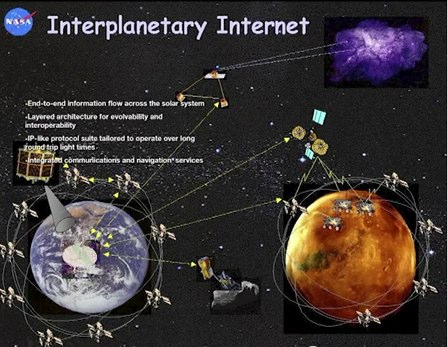
To make this work… and to make it work as seamlessly and easily as possible, it seems to me that we’re really going to want to use IPv6. Sure, it probably works fine initially with IPv4 with the limited number of devices… but as the number of devices increases, who really wants to be fooling around with subnetting or NAT with devices scattered all over the solar system? Far better, I would think, to use an addressing scheme that from the beginning can scale to this level as we continue to add more and more devices into space.
Now, to be clear, I have personally not been involved in any of the “Interplanetary Internet” discussions that have been going on for the last decade or so… but as I listened to that talk, all I could think of was extending the “Internet of Things” idea we use for terrestrial sensor networks out into space on a massive scale. And to me, that means IPv6.
What do you think? Will we need to use IPv6 as we expand out into space?
P.S. And for those interested in learning more about (or contributing to) work around building an interplanetary Internet, here are a couple of links to learn more:
Jun 15
IPv6 Friday: Tutorial on How To Set Up An IPv6 Tunnel From SIXXS
 How easy is it to “IPv6-enable” your network using a tunnel from SIXXS? What are the steps you need to go through to do so?
Over on his “IPv6 Friday” site, Olle Johansson has a post up today about “Eating my own dog food: IPv6-enabling my training class room” where he walks through the steps involved with setting up a tunnel from SIXXS.net on an Ubuntu server. He goes on to explain how to then set up your local network to receive IPv6 addresses via router advertisements.
Kudos to Olle for continuing to publish great tutorials like this and I hope many of you will try this out as a way to get IPv6 connectivity into your current networks!