
Just a guy in Vermont trying to connect all the dots...

Dan York
Author's posts
Feb 20
Reminder: Curling Open House TONIGHT In Petersham, MA – Try It Out!
 Want to try out the sport of curling TODAY? As we mentioned earlier, the Petersham Curling Club is having an Open House free to anyone TONIGHT, Thursday, February 20, from 6-9 pm.
Over 280 people attended last Sunday’s Open House and the PCC has posted some great photos online.
The Petersham Curling Club (PCC) is about 45 minutes south of Keene. Just head south on Route 32 (going down past the Keene airport) and stay on Route 32 all the way down through Richmond, NH, Royalston, MA, Athol and on into Petersham. The club is located right off of Route 32. More information can be found on the PCC directions page. In good weather it takes about 45 minutes to get from Keene down to the Petersham club.
At tonight’s Open House, you’ll learn how to deliver a stone, the role of sweeping and more. This will be a great opportunity to get on the ice and experience the sport yourself. All you need to bring is a pair of clean, rubber-soled shoes and your enthusiasm!
The Petersham Curling Club is a great place to curl and is where several of us involved with starting up the Monadnock Curling Club all curl. We strongly encourage you to head down to Petersham, MA, and check out the Open Houses. And if the curling bug bites you as it has us, please do join the PCC and start playing the awesome sport of curling!
This is where you can get started today and enjoy curling!
And then… please let us know you are interested in seeing curling come to Keene!
Feb 20
Update on DNSSEC Deployment Maps: Github repo for tracking issues, newgTLDs, more…
 The positive reaction to our publishing of DNSSEC deployment maps has been great to hear and I wanted to provide a quick update.
1. The DNSSEC deployment maps are published every Monday. The best way to receive the most current maps is to subscribe to the dnssec-maps mailing list. I will be updating our DNSSEC Deployment Maps web page from time to time when there are major changes, but the most recent maps will always go out to the mailing list. (I’d love to automate the posting to the web page – ideas about how to do so in WordPress are definitely welcome!)
2. There is a Github repository where you can file issues/suggestions. In preparation for making the source code publicly available, we’ve created a repository on Github at https://github.com/Deploy360/dnssec-maps/ We still need to do make some changes to the code to make it publicly available, but in the meantime the major feature of the Github repo is that we now have a convenient place to track “issues”, which could be bugs or feature ideas or more. If you have a Github account (or want to create a free one), you are welcome to raise issues at:
https://github.com/Deploy360/dnssec-maps/issues
I don’t have a timeframe for when we’ll make the code available – it’s honestly a bit of a background task that I’m trying to fit in amongst everything else and with IETF 89 fast upon us it may not happen for a few weeks. Meanwhile, though, the issue tracker is already being helpful.
3. All newgTLDs have been entered up to now. I finally caught up with the backlog of all the DNSSEC-signed “new generic top-level domains (newgTLDs)” that have been delegated by ICANN and now have a DS record in the root zone. These newgTLDs don’t show up in the DNSSEC deployment maps but do show up in the CSV files that are emailed out every Monday. Given that ICANN is delegating more newgTLDs on a weekly basis, it will be a constant effort to update our database, but at least now we’re caught up to the present time.
4. Visualizing the DNSSEC status of the generic TLDs is of interest. As I noted in a recent post here, I would like to think about how we could provide an image in the email that visualizes the DNSSEC status of all the generic TLDs, both the “newgTLDs” and all the ones that existed before. Suggestions and ideas would be welcome, either to this post or to the “issue” on Github.
That’s the quick update… I am glad some folks are finding this service useful and welcome any comments and feedback. Thanks!
Feb 20
Smithsonian: Why Curling Ice Is Different Than Other Ice
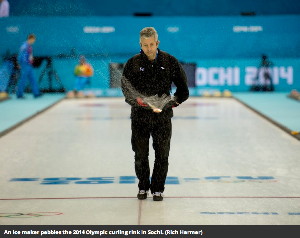 What makes curling ice so different than other ice? What extra preparation has to be done to the ice? And how does sweeping really work?
The Smithsonian Magazine has a great article out this month that dives into detail about what goes into making curling ice – and how it is different from, say, ice used for figure skating or hockey. The key part about the ice is:
If curling ice was flat, the stone would move barely halfway across the “sheet,” or curling lane. And that’s assuming the curler is hurling it as hard as possible. Friction would halt the rock within seconds. So, to make the ice more amenable to the sport, devoted ice makers employ a technique called “pebbling.” More or less what it sounds like, pebbling involves freezing small droplets of water across the playing surface between each match.
Curling stones weigh 44 pounds. They are concave, on bottom, which limits the contact they have with the ice. The curling stone’s concave bottom, which limits how much it comes into contact with the ice, and the pebbles reduce friction. Essentially, the pebbles melt a bit when the heavy stone runs across them, creating a micro-layer of water upon which the stone can glide.
The pebbles create the “spin” (or curl, hence the sport’s name) of the stone after it’s released, at least in part; physicists contend that something called “wet friction” also accounts for the curl. Sweepers—those furious ice brushers who’ve become fodder for Olympic memes and GIFS—use a broom to brush the pebbles, thereby changing how the stone spins. Specific techniques melt the pebbles, reducing friction and helping the stone travel even farther and straighter. Naturally, the game changes as the pebbles erode, and sweepers have to constantly compensate.
The article goes on to talk about the efforts made by professional ice-makers (and yes, there are those people) to prepare the ice for events such as the Sochi Olympics. It’s well worth a read to understand why curling ice is different!
(And if you found that interesting, please sign up to help us bring curling to Keene!)
Feb 20
Smithsonian: Why Curling Ice Is Different Than Other Ice
What makes curling ice so different than other ice? What extra preparation has to be done to the ice? And how does sweeping really work?
The Smithsonian Magazine has a great article out this month that dives into detail about what goes into making curling ice – and how it is different from, say, ice used for figure skating or hockey. The key part about the ice is:
If curling ice was flat, the stone would move barely halfway across the “sheet,” or curling lane. And that’s assuming the curler is hurling it as hard as possible. Friction would halt the rock within seconds. So, to make the ice more amenable to the sport, devoted ice makers employ a technique called “pebbling.” More or less what it sounds like, pebbling involves freezing small droplets of water across the playing surface between each match.
Curling stones weigh 44 pounds. They are concave, on bottom, which limits the contact they have with the ice. The curling stone’s concave bottom, which limits how much it comes into contact with the ice, and the pebbles reduce friction. Essentially, the pebbles melt a bit when the heavy stone runs across them, creating a micro-layer of water upon which the stone can glide.
The pebbles create the “spin” (or curl, hence the sport’s name) of the stone after it’s released, at least in part; physicists contend that something called “wet friction” also accounts for the curl. Sweepers—those furious ice brushers who’ve become fodder for Olympic memes and GIFS—use a broom to brush the pebbles, thereby changing how the stone spins. Specific techniques melt the pebbles, reducing friction and helping the stone travel even farther and straighter. Naturally, the game changes as the pebbles erode, and sweepers have to constantly compensate.
The article goes on to talk about the efforts made by professional ice-makers (and yes, there are those people) to prepare the ice for events such as the Sochi Olympics. It’s well worth a read to understand why curling ice is different!
(And if you found that interesting, please sign up to help us bring curling to Keene!)
Feb 19
TDYR #105 – The Good News That IPv6 Deployment *IS* Happening Around The World
If you are in IT and have been avoiding learning about IPv6 because you think it will never happen, new measurements show that it IS being deployed around the world! More info and stats here: http://www.circleid.com/posts/20140219_anyone_who_still_thinks_ipv6_wont_happen_isnt_watching_measurems/
Feb 19
Anyone Who Still Thinks IPv6 Won’t Happen Clearly Isn’t Watching the Measurements (Featured Blog)
Anyone who still is using the "I'll-just-wait-on-IPv6-because-it-will-never-happen" approach is clearly NOT watching the measurements. First, there was the news last week that Google's IPv6 measurement had crossed over 3% less than five months after crossing the 2% mark. Then today comes word from the World IPv6 Launch measurements program that the February 2014 measurements are up... More...
Feb 19
New IPv6 Measurements: Comcast nearing 25%, Verizon Wireless 46%, DT at 18%
 Great news out of the World IPv6 Launch measurements this month! As our colleague Mat Ford writes, Belgium’s Telenet is a new entrant into the measurements that is already showing an impressive 12.17% deployment of IPv6. Congratulations to the team there for making that happen!
Scanning down the February 2014 measurements, there are some other interesting points, too:
- Comcast is nearing 25% IPv6 deployment as compared to a measurement of just over 16% in November 2013.
- Time Warner Cable is up to 5.37% vs just under 3.5% back in November.
- Deutsche Telekom grew from just under 16% last month to now basically 18% deployment.
- Verizon Wireless continues to show strong growth with 45.75% IPv6 deployment.
- Other North American wireless operators have a good showing, too, with AT&T at 16.77% and T-Mobile USA at 15.76%.
- Google Fiber is showing over 76% IPv6 deployment.
- Free in France showing 37% IPv6 deployment.
Much more to see as you look down the measurement set.
Keep in mind that as mentioned on the bottom of the World IPv6 Launch measurements page, the measurements are for the % of IPv6 deployment that is seen from each registered network by the four companies participating in the measurements program: Google, Facebook, Yahoo! and Akamai. The various methodologies used by the four companies are explained at the bottom of that page.
Is your network already using IPv6? Would you like to join in the World IPv6 Launch measurements program? If so, just fill out the form.
And if you network is NOT yet using IPv6, how can we help you? (Check out our IPv6 resources to get started.)
Feb 18
TDYR #104 – That Moment You Realize You Don’t Have To Watch The Olympic Livestreams… Live!
Today I had one of those moments when you realize how much the Internet has changed everything...
Feb 18
How Can We Visualize Generic TLDs (and newGTLDs) In Our DNSSEC Deployment Maps?
 What is the best way to visualize the DNSSEC deployment status of the “generic top-level-domains (gTLDs)” in our DNSSEC deployment maps that go out weekly? Obviously since gTLDs (including the “newgTLDs”) are not tied to a country, there is no way to display them on an actual map as we do for all the ccTLDs.
Given that, how else could display the gTLDs in a way that is useful? Right now, their DNSSEC deployment status is included in the CSV files that are sent out to subscribers of the dnssec-maps mailing list (to which anyone can subscribe). But could we create an image of some type that showed the different deployment states? Perhaps something like the image in this post (only with the actual Unicode characters)?
And what would be the best way to do that given that we’ll soon have hundreds and maybe even thousands of generic TLDs?
My primary interest is to have some image that we can use in presentations (or on a website) that visualizes the current state of DNSSEC deployment within the gTLDs. We’re tracking the data in our database… we just need some way to make it more interesting then simply a list out of a CSV file.
I’d be curious to hear any feedback you all may have, either left as a response to this blog post, as a comment on the issue I opened up on Github, in social media where this is posted or as email back to us.
And then, of course, I need someone with sufficient python background working with image-generation libraries who can help make the visual image a reality… but let’s perhaps figure what we want first, eh?
Feb 17
Useful Internet-Draft: IPv6 Operational Guidelines for Datacenters
 What should data center operators think about with regard to IPv6? One of the Internet Drafts in the V6OPS working group within the IETF aims to address this issue. The latest version was just released two weeks ago on February 3, 2014, and can be found at:
http://tools.ietf.org/html/draft-ietf-v6ops-dc-ipv6
As the abstract notes:
This document is intended to provide operational guidelines for datacenter operators planning to deploy IPv6 in their infrastructures. It aims to offer a reference framework for evaluating different products and architectures, and therefore it is also addressed to manufacturers and solution providers, so they can use it to gauge their solutions. We believe this will translate in a smoother and faster IPv6 transition for datacenters of these infrastuctures.
The document focuses on the DC infrastructure itself, its operation, and the aspects related to DC interconnection through IPv6. It does not consider the particular mechanisms for making Internet services provided by applications hosted in the DC available through IPv6 beyond the specific aspects related to how their deployment on the Data Center (DC) infrastructure.
Apart from facilitating the transition to IPv6, the mechanisms outlined here are intended to make this transition as transparent as possible (if not completely transparent) to applications and services running on the DC infrastructure, as well as to take advantage of IPv6 features to simplify DC operations, internally and across the Internet.
The document then goes on to look at the various stages of a transition to IPv6 and explores various methods by which the transition can occur. It also addresses operational considerations such as IPv6 address planning, monitoring and logging, and management systems. Like other similar documents, it also includes many links for data center operators seeking to learn more.
If you operate a data center, you may find this document quite helpful!
P.S. I’ll note that the authors are definitely looking for feedback and so if you have suggestions based on your own experience with IPv6 in your data center, please do contact them – their email addresses are at the end of the document.