
Just a guy in Vermont trying to connect all the dots...

Dan York
Author's posts
Oct 05
Reflections On Ello – October 5, 2014
First, as I wrote, we have to remember that Ello is not Facebook, Twitter, Google+, etc., and we have to just go in with an open mind.
The Ello platform is very definitely still a "beta" with a long list of features that they want to add, but over the past bit there have been some changes of interest:
- The Ello team has now release "muting" and "blocking" so that you can control a bit more of the experience you have on Ello.
- Kevin Marks had some good commentary about how this issue is hard - and how it is also important to the IndieWeb and other activities.
- Cmd+Return on my Mac (Ctrl+Enter on a PC) has now become my favorite keystroke because it lets me rapidly submit comments or posts without using the mouse.
- You can press "f" and "n" to toggle between your "friends" and "noise" lists.
- There are several other quick keys that let you shift between different views.
- The mobile interface works well once you understand that you can swipe left and right to do more.
- Writing with markdown and emoji is fun!
I love the display of photos in Ello, but there's one bit of brokenness that does bother me:
- There are issues posting "portrait" photos from a smartphone, although there is a workaround to make them square first.
I asked the question of why should Ello have to have a mobile app and wondered about how Ello behaved different from other apps... and I learned a bit more about why (and what you can do)
Clay Shirky had two great posts about Ello being a conversational versus annotative medium:
He also had two other good articles and threads:- How he does NOT want a 'reshare' link and why Ello to him is more like LiveJournal and USENET
- How challenging it is to find comments you have left on Ello
Oh, and there's now a parody social network... Owdy! :-)
Please do join me on Ello if you are interested in the continuing experiments... and please feel free to share your own tips and insights!
If you found this post interesting or useful, please consider either:
- following me on Twitter;
- following me on Ello;
- adding me to a circle on Google+;
- subscribing to my email newsletter; or
- subscribing to the RSS feed.
Oct 03
Join Me On VUC Today At Noon US EDT To Talk IPv6, IoT, WebRTC and more…
Today at 12 noon US Eastern (in about 3.5 hours), I'll be part of a panel on the VoIP Users Conference (VUC) talking about IPv6, WebRTC, the Internet of Things (IoT) and much, much more... you should be able to watch it live at live.vuc.me or embedded here:
VUC host Randy Resnick had a scheduled guest be unable to attend and so he asked a group of us to come on for what he is calling a "VUC Vision" session. I will be on there, as will, I believe, Tim Panton and a number of others. I expect the discussion should range over good variety of topics. It should be a good time... you're welcome to join in the discussion.
It's probably best to also join the IRC backchannel where links are shared, questions are answered and other comments occur. You also can visit the Google+ event page for the VUC session today where there may be additional links and info.
If you won't be at your computer, you can also call in via:
- sip:200901@login.zipdx.com
- +1 (646) 475-2098
- Skype:vuc.me
The session will of course be recorded so you can listen/watch later.
If you found this post interesting or useful, please consider either:
- following me on Twitter;
- adding me to a circle on Google+;
- following me on Ello;
- following me on App.net;
- subscribing to my email newsletter; or
- subscribing to the RSS feed
Oct 02
CEA Webinar Archive: Making Content Available On IPv6 and Ensuring the Optimal Customer Experience
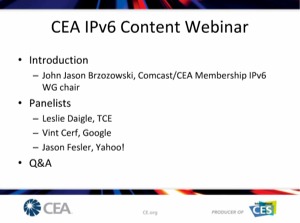 How can you make your content available over IPv6 and ensure the optimal customer experience? That was the topic of a excellent recent webinar from the Consumer Electronics Association (CEA) on September 16, 2014, featuring these panelists:
- John Jason Brzozowski, Comcast (and CEA IPv6 Working Group chair)
- Leslie Daigle, TCE
- Vint Cerf, Google
- Jason Fesler, Yahoo!
The session is now available for your listening and viewing at:
https://consumerelectronics.adobeconnect.com/_a89885078/p2d42e4ygya/
The abstract for the session is:
While some mainstream content providers have enabled their content to be available over both IPv4 and IPv6, a large population of the same continues to be available only over IPv4. Join this webinar to learn why making your content available over IPv6 is critical to the IPv6 transition and more importantly to ensure an optimal customer experience. As part of this webinar, manufacturers, service providers and retailers in the consumer electronics industry will learn why support for IPv6 is important as the steps required to ensure popular consumer electronics are enabled to support and actively using the same.
It was great to hear Leslie Daigle again (given that she used to be involved here) and she started out the session providing statistics about IPv6 and speaking about the impressive growth we’ve seen over the past few years.
Vint Cerf spoke next and first talked about Google’s strong commitment to IPv6 and then discussed what is happening with Nest thermometers (owned by Google) and the new “Thread” protocol being advanced by a group of companies as a method of enabling the “Internet of Things (IoT)”. Thread is based on IPv6 using the 6LoWPAN technology and provides a powerful way to interconnect devices and services. (I’ll note that earlier this week there was apparently a gathering at Google’s California campus where many people involved with Thread met and provided an update on the project.)
Jason Fesler then spoke about the business case for deploying IPv6 for content providers. His number one reason was that companies need to “ensure the best possible user experience for our customers.” He noted that it is not a matter so much of what IPv6 brings us, but rather what is the future of IPv4. He talked about the challenges of carrier-grade NAT (CGN) and how it limits the ability of a content provider to optimize content for an individual user. He also spoke of the dangers of CGN in potentially blocking an entire network due to a single bad actor. Jason then discussed how Yahoo! is preparing to make its web sites and content available to IPv6-only networks, as they do expect to see more of such networks in the years ahead.
After the presentations there was a lengthy Q&A session and more ongoing discussion.
This CEA Webinar was the second in a series of webinars about IPv6. The first was last month and focused on IPv6 and broadband. My colleague Phil Roberts wrote about that session (and participated in it) and provided the link to the archive of that session.
It’s great to see these sessions coming from the CEA and we look forward to future webinars!
If you want to get started making your content available over IPv6, please visit our Start Here page to find resources available to help you. In particular, the IPv6 information for website owners and content providers may be of great help.
Sep 30
Just testing that status updates do appear as they are expected to do.
Just testing that status updates do appear as they are expected to do.
Sep 30
R.I.P. Orkut, The First "Social Network" Many Of Us Used
Orkut was quietly launched in late January 2004 ... ten years ago ... and I can dive back into Advogato where I used to write in those days and see that:
- I got an invite on Feb 1, 2004, and wasn't really sure what it was all about.
- On Feb 2, 2004, I wrote that there were a ton of rants against Orkut. (Gee, sounds familiar given the current rants against Ello.)
- On Feb 5, I set up a "community" on Orkut related to DocBook.
And... then that's pretty much all I seem to have written about Orkut... outside of a post in 2008 about Orkut planning to use OpenSocial (remember OpenSocial?).
And that's somewhat symptomatic of what happened to Orkut... other sites and social networks emerged that captured more of our attention. As the Wikipedia article about Orkut notes, the site became for a while a huge community for users in Brazil and also India... so huge in Brazil, in fact, that the site wound up ultimately being managed by Google's office in Brazil (and this is undoubtedly why the "community archive" appears in Portuguese).
But for many of us outside those regions, we moved on. Some to Friendster and MySpace... then to Twitter in 2006... Facebook... and tens of other social networks that are now lost to history... (ReadWrite has a nice timeline about the rise and fall of Orkut, including how Facebook overtook Orkut in Brazil in 2012.)
When Google announced back in June that Orkut would be shutting down today, it had been so many years that I couldn't even easily find my account on Orkut. With all of Google's various "accounts", there were a bunch of "Dan York" accounts... and my Orkut account wasn't among them. Obviously I'd missed that point in time when Orkut users were supposed to link their Orkut accounts to their Google accounts.
Still, it's worth pausing for a moment to remember Orkut. It was the first time that many of us dealt with "friends" and "fans". It's instructive to read this rant from danah boyd, venting my contempt for orkut... the whole "social networking" thing was so brand new in those days. Friendster was around, and a few others, but not many. Danny Sullivan's piece from that time is a good read, too.
And sadly, we never really got the "protocol for networking the social networks" that David Weinberger thought might arise (although there have been many attempts (recent example, the "IndieWeb", although that is more about linking publishing sites than true "social networks", but there is a 'social' aspect to it)).
R.I.P., Orkut ... you had a good run... and you helped introduce many of us to the concepts that would become simply part and parcel of the "social" world in which we live today.
UPDATE 1 Oct 2014 - Interesting infographic about the history of Orkut: Bye bye Orkut – A Look back into the History of Orkut
You can hear an audio commentary on this topic on SoundCloud:
If you found this post interesting or useful, please consider either:
- following me on Twitter;
- adding me to a circle on Google+;
- following me on Ello;
- following me on App.net;
- subscribing to my email newsletter; or
- subscribing to the RSS feed.
Sep 30
TDYR #175 – R.I.P, Orkut
As many of us play with Ello, the newest social network to attract attention, I take a moment to remember Orkut, the first "social network" many of us used way back in 2004... and that was shut down today, September 30, 2014, by Google...
Read more: http://www.disruptiveconversations.com/2014/09/rip-orkut-the-first-social-network-many-of-us-used.html
Also posted on Ello, of course: https://ello.co/danyork/post/kF7_SrLsE-ThvqLFmB79Mw
Sep 30
TDYR 175 – R.I.P Orkut
TDYR 175 - R.I.P Orkut
As many of us experiment with Ello, the latest social network to attract interest, I pause for a moment to remember Orkut, the first "social network" site that many of us experimented with way back in 2004 ... and that was finally shut down by Google today...
(also experimenting with posting an audio file via Known out to SoundCloud and other sites)
Sep 30
Watching ‘Known’ Grow… via Github
But the cool part about Known is that like most open source projects it has an open issue tracker... in this case Known uses Github. The overall Github account is https://github.com/idno ("idno" was the original name of the project before they changed it to "Known") and you can find repositories there for the main Known source code (/idno) as well as various plugins that work with Known, themes and other materials.
But it is the "issues" that I find most interesting. If you go to:
https://github.com/idno/idno/issues
You'll see all the currently open issues along with the ensuing discussion. Perhaps more interestingly you can see the closed issues at:
https://github.com/idno/idno/issues?q=is%3Aissue+is%3Aclosed
to see all the great work the Known development team has been doing.
Being a Github user, I have "watched" the idno repository and chosen to receive email notifications when there are new issues or new posts about issues.
The result has been a fascinating glimpse into the development process of the team... and it's just been fun to watch how they continue to build more functionality into the platform. Great to see!
If you found this post interesting or useful, please consider either:
- following me on Twitter;
- adding me to a circle on Google+;
- following me on App.net;
- subscribing to my email newsletter; or
- subscribing to the RSS feed.
Sep 29
Why I Am NOT Always Okay Being The Product (Re: Facebook and Ello)
Today Shel Holtz published a piece on his blog, "You say I'm the product of services I don't pay for? I'm fine with that.", and after first replying to Shel on Ello and then starting to do so again on Facebook... I realized I needed to just write these thoughts down in somewhere more permanent (and outside the walls of social networks). You know... go "old school" and reply blog-to-blog like we used to do before social networks...
I certainly realize that you are always paying for services in some form, either directly in money or attention (i.e. watching an ad before seeing something) or through information that can then be monetized via some other way such as ads. I also realize there are hybrid services where you are directly paying for part of the cost while advertising (potentially based on your data) is covering the rest of the cost. This has been the model for newspapers and magazines for quite some time (and pre-Internet, of course). It's the model for TV channels now (since in at least the US you are paying for cable TV and being bombarded by ads). It's the model used for a zillion different services we all use every day.
I get that.
TANSTAAFL - There Ain't No Such Thing As A Free Lunch
I get that. And much of the time I'm perfectly fine with that.
I use Gmail, for free, even though I know that Google is reading my every message and mining that for data to feed into their AdWords advertising machine. Like Shel, I use some "loyalty programs" where I know that I am getting a discount on my purchases in exchange for giving them my data.
Going Too Far?
But... I start to get worried about how that data might be used by others. For instance, Facebook's new "Atlas" advertising platform launches today (see also "Meet the new Atlas") and so now ads based on our Facebook data will be displayed on other websites we visit and also within mobile apps.To Shel's point... maybe that's a good thing. Maybe we'll see more targeted and helpful ads that we may actually want to purchase.
But... who else is learning about what we are doing and saying inside of Facebook... and are we okay with them doing so?
Maybe I've just spent so many years in information security that I'm wary. I don't expect that advertisers outside of Facebook would learn my exact information... Facebook is far too protective of the actual data (for their OWN reasons, not out of any interest in protecting me). But there are ways that information can leak... or that aggregate information can be discovered. Our web browsers and other devices can leak a great amount of information about what we are doing and what we are seeing.
I'm not 100% okay sharing all that data with others.
I guess I don't necessarily trust Facebook to be careful with my data.
Choosing NOT To Be The Product
Shel mentions network television in his post, and certainly I, too, have seen some amazing shows that came about through the support of advertising. Similarly, I'm been a long-time fan of National Public Radio (NPR) and while it does not have "advertising", per se, it has "underwriting" which to the listener may wind up being similar (just less obnoxious).
But I have chosen to NOT participate in that process much any more. Our family doesn't have commercial TV. We are a "cord-cutter". What "TV" we watch comes at us without commercials through live streaming services. We are paying for a subscription. An impact, of course, is that we don't get some of the latest shows... nor do we get the current sports games... because those are all still ad-funded.
We made this choice in large part because we were tired of all the advertising. (And there are some philosophical reasons why I think the fact that our kids are growing up without watching commercials is a beautiful thing, but that's for a different article.) I've given up on most traditional radio, too, including NPR, opting instead to listen to podcasts in my car or use Spotify (which I pay for) or other streaming services in my home office.
Similarly, I have chosen NOT to participate in some "rewards" or "loyalty" programs offered by some stores or services. Oh, sure, I'm in various hotel and airline "frequent traveler" programs because I perceive that there are benefits. I am also in one for my local hardware store because I get a discount and I buy a significant quantity of products to where I'm okay giving up my data for a discount.
But there are other stores where I am NOT comfortable exchanging my data for a discount. Either ones I don't frequent all that often... or just ones that for whatever reason I don't trust.
I don't want to be their product.
Returning To The Topic Of Facebook and Ello
Shel concludes his post saying:
Ultimately, being “the product” doesn’t bother me, and I’m not inclined to abandon a network that works for me for a new one just because it doesn’t have ads.
He is, of course, responding to the Ello Manifesto and one reason Ello is getting a good bit of buzz.
I agree that simply "not having ads" is not a great reason to move from one network to another. And I don't expect that I will abandon Facebook... I still find it useful and enjoyable.
But I find I don't trust Facebook anymore.
Granted, I never really have trusted Facebook since I started using it back in 2007-ish... but maybe it's even more the case today. I just worry about the large-scale data mining.
THAT is a good part of why I'm continuing my explorations with Ello.
I'm looking for a place where I can share information with others - and yet feel that the privacy of my conversations and data are better respected than in other social networks.
P.S. And yes, I do realize the irony that all my Ello conversations are entirely public, which means that all of them can be picked up by that other master of data mining, Google, as well as any other data mining service... very much like all my tweets can be picked up, too. That's okay right now because I'm not yet intending to share anything on Ello that I'm not comfortable being public. But I am interested in what they may be able to do in the future to allow more private conversations.
P.S. And I also realize that I'm probably in a very small minority who care about data privacy and that the VAST majority of people out there don't even remotely care about what is done with their data...
Photo credit: Shel's blog
If you found this post interesting or useful, please consider either:
- following me on Twitter;
- adding me to a circle on Google+;
- following me on App.net;
- subscribing to my email newsletter; or
- subscribing to the RSS feed.
Sep 29
Verizon Wireless Hits 56% IPv6, T-Mobile USA 40%, AT&T 24%
The September 2014 World IPv6 Launch measurements came out last week showing continued strong growth of IPv6. Verizon Wireless’ deployment edged up over 56%. T-Mobile USA is now over 40% IPv6. AT&T is getting closer to hitting 25%. Telefonica del Peru crossed over the 10% milestone. As Mat Ford wrote over on the World IPv6 Launch site:
We continue to see very encouraging growth in measured deployment across hundreds of networks both large and small.
And that is indeed the case!

Of course, not all the networks grew this month. A few were basically flat and a couple registered declines, but the overall trend is certainly in the positive direction we would like to see – and this backed up by what we see from other IPv6 statistics sites, including Google’s IPv6 trend line that just went over 4.5% this weekend.
The reality is that IPv6 is being deployed globally – if you aren’t already making plans to ensure that your online content is available over IPv6 and your networks can work with IPv6, please visit our Start Here page to find resources tailored to your type of environment to help get started!